One thing I appreciate about Tokyo is that there are no extra friends. Every acquaintance is important. I can't afford neglect.
In California one might say: “Oh, we can’t really be friends—I’m vegan, she’s ovo-lacto.” Or: “My Buddhism is Zen, he’s Kagyu Kadampa.”
Whereas in Tokyo there’s only the delighted shock of recognition: “You drink beer! Ohmigod! I drink beer!”
Vegetarians are driven to befriend carnivores, even though it means they must subsist some evenings on nothing but green soybeans. Swedes and Texans swap accents. Driven to new heights of recklessness, Americans start learning languages.
Irritating people—such as myself—are nonetheless retained as friends. Quirks and compulsions pose no bar. There’s time to chat with the Jehovah’s Witnesses, to flirt with the Mormons. Some people even strike it up with Republicans.
Gratitude expands to fill the space dug out by loneliness; we learn to practice conservation of the human.
Friendship fed by shared relief. Here at last: a face that doesn’t slam shut at the sight of me.
Showing posts with label Nagusami. Show all posts
Showing posts with label Nagusami. Show all posts
Saturday, November 11, 2006


Friday, November 10, 2006
Nagusami / 39
Some nights my friends are barely visible within their oily clouds of pain, that sickly iridescence littered with bad men, with what was said, and the last seven drinks.
Enter tonight’s jilted lover. We buy him beer and rub his back and step away to piously assure each other that, really, it was his own fault.
“I knew all along it wasn’t real.”
“I didn’t believe it for a second.”
This is how the world works. None of it's real and it all hurts.
I wouldn’t put up with it--except soon it will be my turn to be the heartsick fool--my toy lying broken on a street corner in Shinjuku.
It is impossible to say to whom the pain belongs. Grief scampers from table to table. We all take turns sitting up with it and we feed it from the tiny bottle, many, many times an hour.
Enter tonight’s jilted lover. We buy him beer and rub his back and step away to piously assure each other that, really, it was his own fault.
“I knew all along it wasn’t real.”
“I didn’t believe it for a second.”
This is how the world works. None of it's real and it all hurts.
I wouldn’t put up with it--except soon it will be my turn to be the heartsick fool--my toy lying broken on a street corner in Shinjuku.
It is impossible to say to whom the pain belongs. Grief scampers from table to table. We all take turns sitting up with it and we feed it from the tiny bottle, many, many times an hour.
Wednesday, November 08, 2006
Nagusami / 38
Security is a false god; begin making sacrifices to it and you are lost. Paul Bowles
Comfort is an exemplary verb. Everyone has a high opinion of it. We’d like to ship it round the world and if we could we’d soak the earth in it.
The noun, comfort, is not entirely reprehensible, though already there’s a whiff of the lifestyle magazine, of homes in gated communities. There’s a wall certainly, and also a door that locks. You’d like to have it for your children. You hope it extends into old age.
(Is it possible to think of comfort, really, without also feeling afraid?)
The adjective, comfortable, is entirely dubious, though my husband doesn’t think so. What’s wrong with being comfortable? he asks. We’re doing well as anyone, rock-a-bye, treetop.
Comfortable, it seems to me, is the fine print on a sleeping pill. There’s an ominous warmth. The dog circles three times and lies down for a nap.
The Reverend Hartman, at home in Winesburg, wonders if the flame of the spirit really burns in him, decides, “Oh well, I suppose I’m doing well enough.”
Is that smell smoke? Do these windows open?
I remember the day I read, in a poem by Luis Cernuda, Comfort is corrosive. I felt relieved, as when the doctor admits, “This is going to hurt.”
Comfort is an exemplary verb. Everyone has a high opinion of it. We’d like to ship it round the world and if we could we’d soak the earth in it.
The noun, comfort, is not entirely reprehensible, though already there’s a whiff of the lifestyle magazine, of homes in gated communities. There’s a wall certainly, and also a door that locks. You’d like to have it for your children. You hope it extends into old age.
(Is it possible to think of comfort, really, without also feeling afraid?)
The adjective, comfortable, is entirely dubious, though my husband doesn’t think so. What’s wrong with being comfortable? he asks. We’re doing well as anyone, rock-a-bye, treetop.
Comfortable, it seems to me, is the fine print on a sleeping pill. There’s an ominous warmth. The dog circles three times and lies down for a nap.
The Reverend Hartman, at home in Winesburg, wonders if the flame of the spirit really burns in him, decides, “Oh well, I suppose I’m doing well enough.”
Is that smell smoke? Do these windows open?
I remember the day I read, in a poem by Luis Cernuda, Comfort is corrosive. I felt relieved, as when the doctor admits, “This is going to hurt.”
Tuesday, November 07, 2006
Nagusami / 37
A note from Yuuichiro, that gentleman most dapper, most immaculate, teaches me: In verb form, the word ‘nagusameru’ means ‘to comfort’, as in providing psychological relief when someone is under stress.
Comfort. The word appears to me in flames.
In this city we come to know intimately the pleasures and dangers of comfort. Comfort. The pillow, the nurse, the smothering.
Comfort. The word appears to me in flames.
In this city we come to know intimately the pleasures and dangers of comfort. Comfort. The pillow, the nurse, the smothering.
Saturday, October 07, 2006
Saturday, September 30, 2006
Nagusami / 36
(Tokyo, 2006)
It’s 0:11 at Shinjuku’s South Exit and the skinny lovers are climbing the stairs hand-in-hand toward the ticket gates.
From the bridge just above I can see the glowing screens of their cellular phones and for once they seem like fireflies: the boys and girls have captured a glowing piece of ecstatic neon Shinjuku and are carrying it home carefully, cupped in their hands.
Midnight is the time of taking down. A helmeted blue suited guide waves traffic through with his uplifted flashing orange wand. Lovers draw their hands across each other cheeks from brow to neck.
I thought this was the hour of hurry and regret. There’s none of that. On a steel fence that encircles a single tree a young man and woman still sit, dangling their legs.
One big hair boy with a silver duffel tugs at his crotch. The clock’s immense minute hand moves forward one.
It’s 0:12 and they had fun and still were good. They are in time, will make it home tonight.
It’s 0:11 at Shinjuku’s South Exit and the skinny lovers are climbing the stairs hand-in-hand toward the ticket gates.
From the bridge just above I can see the glowing screens of their cellular phones and for once they seem like fireflies: the boys and girls have captured a glowing piece of ecstatic neon Shinjuku and are carrying it home carefully, cupped in their hands.
Midnight is the time of taking down. A helmeted blue suited guide waves traffic through with his uplifted flashing orange wand. Lovers draw their hands across each other cheeks from brow to neck.
I thought this was the hour of hurry and regret. There’s none of that. On a steel fence that encircles a single tree a young man and woman still sit, dangling their legs.
One big hair boy with a silver duffel tugs at his crotch. The clock’s immense minute hand moves forward one.
It’s 0:12 and they had fun and still were good. They are in time, will make it home tonight.
Monday, September 25, 2006
Nagusami / 35
Forgive me if you’ve heard this before. A few moments in any life are small durable flashlights to clutch against the pitch vast lurching dark.
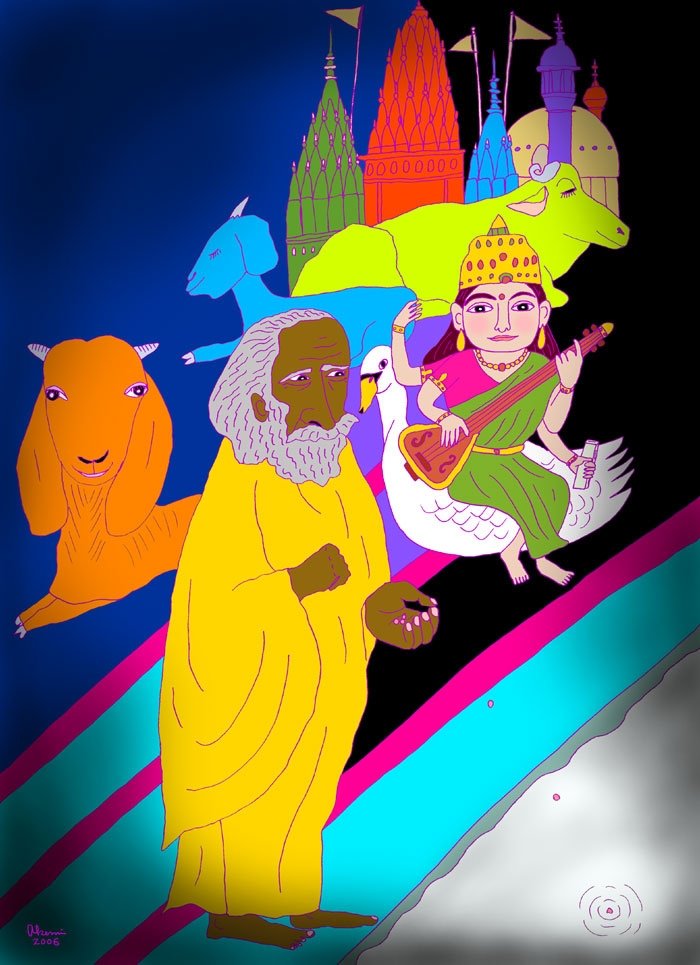
In Banaras, around the time of the Sarasvati festival, I went walking alone on the ghats late at night. The steps of the ghats are steep and uneven and there are sudden drops. The riverfront, famed for its colors at dawn, is ghostly at night, lit only by an occasional cold floodlight from the old fort or ashram.
Walking down by the river, I saw someone standing wrapped in a blanket on the river’s edge. I couldn’t see much but I could hear him chant very slowly, in baritone, a name of God. At the end of each mantra he threw into the water what sounded like a tiny pebble.
I sat behind him on the stone steps, not too close, but near enough to be warmed by his voice chanting Sri Ram. . .Jai Ram. . .Jai Jai Ram. No other sounds but footsteps on stone faraway or, a few times, an oar in the water.
Finally, at the end of his devotions, the man turned around and saw the scrawny foreigner who’d huddled by his voice as by a fire. He smiled, showing his teeth in the dark and held his hand out to me. His cupped palm still held a few tiny pieces of sugar candy.
His voice was quiet and certain. He said, “It is important work-fish-feeding.”
In Banaras, around the time of the Sarasvati festival, I went walking alone on the ghats late at night. The steps of the ghats are steep and uneven and there are sudden drops. The riverfront, famed for its colors at dawn, is ghostly at night, lit only by an occasional cold floodlight from the old fort or ashram.
Walking down by the river, I saw someone standing wrapped in a blanket on the river’s edge. I couldn’t see much but I could hear him chant very slowly, in baritone, a name of God. At the end of each mantra he threw into the water what sounded like a tiny pebble.
I sat behind him on the stone steps, not too close, but near enough to be warmed by his voice chanting Sri Ram. . .Jai Ram. . .Jai Jai Ram. No other sounds but footsteps on stone faraway or, a few times, an oar in the water.
Finally, at the end of his devotions, the man turned around and saw the scrawny foreigner who’d huddled by his voice as by a fire. He smiled, showing his teeth in the dark and held his hand out to me. His cupped palm still held a few tiny pieces of sugar candy.
His voice was quiet and certain. He said, “It is important work-fish-feeding.”
Sunday, September 24, 2006
Nagusami / 34
Mary, of course, was not her real name. She told her real name once, to a visiting missionary, and Ebenezer beat her for it and the missionary forgot the name.
Mary shouldn’t be talking. Mary ought to be scrubbing the floor, sorting the rice, cooking chapatti over the kerosene fire.
At night Mary coughed, an awful cough that shook the house. She’d been dying in her village when Ebenezer came huffing and puffing down the bicycle path because his old Ambassador car couldn’t squeeze through.
Mary, the village tomato lady, was taken to Hyderabad and in return it was only fair that she should serve Ebenezer in his kitchen and in his bed.
Mary did talk however and even learned a little English from the visiting missionaries and hearing Ebenezer talk to the charity money men.
Of course she made some mistakes. For example, she never learned that hungry and angry were two separate words. If you were ‘hangry’ she immediately brought dhal and chapattis.
This particular mistake proved never to be an obstacle.
She said, “You like me. I like you. You no like me. I no like you.”
She even taught a little of her language to the visiting missionary who couldn’t be expected to remember. One night on the roof of the house in Hyderabad where she was prisoner she lifted her hands to the full moon and instructed,
Chan-dha Ma-ma Ra-vay!
Moon Mother, Come!
Mary shouldn’t be talking. Mary ought to be scrubbing the floor, sorting the rice, cooking chapatti over the kerosene fire.
At night Mary coughed, an awful cough that shook the house. She’d been dying in her village when Ebenezer came huffing and puffing down the bicycle path because his old Ambassador car couldn’t squeeze through.
Mary, the village tomato lady, was taken to Hyderabad and in return it was only fair that she should serve Ebenezer in his kitchen and in his bed.
Mary did talk however and even learned a little English from the visiting missionaries and hearing Ebenezer talk to the charity money men.
Of course she made some mistakes. For example, she never learned that hungry and angry were two separate words. If you were ‘hangry’ she immediately brought dhal and chapattis.
This particular mistake proved never to be an obstacle.
She said, “You like me. I like you. You no like me. I no like you.”
She even taught a little of her language to the visiting missionary who couldn’t be expected to remember. One night on the roof of the house in Hyderabad where she was prisoner she lifted her hands to the full moon and instructed,
Chan-dha Ma-ma Ra-vay!
Moon Mother, Come!
Saturday, September 23, 2006
Nagusami / 33
Those who went into these “bad places” entered an intoxicating, out-of-the-ordinary, festival-like world where the line between reality and dream was blurred.
--Haruo Shirane
(Phuket, 2005)
So cautiously, so gingerly, he pushed open the gray anonymous door -
Hey sexy!
Two dozen big boys under black lights in white spandex laughing waving to him from the stage.
Well. There wasn’t really any choice, was there now, but to go in?
--Haruo Shirane
(Phuket, 2005)
So cautiously, so gingerly, he pushed open the gray anonymous door -
Hey sexy!
Two dozen big boys under black lights in white spandex laughing waving to him from the stage.
Well. There wasn’t really any choice, was there now, but to go in?
Thursday, September 07, 2006
Nagusami / 32
(Tokyo, 2006)
I’d like a street-smart master, rather than the pious rural model—the sort of guru who might accost one at a late-night coin laundromat. I’d bring that guru beer instead of marigolds, food stamps instead of the pious envelope of cash.
I worry the first thing that guru'd do, if my master ever deigned to appear in Tokyo, is make me give up my special space on the train, the standing space in the nook just beside the door. On the train with the rush hour crowd, ass against the wall, that space makes it all much easier to bear.
I’ve become expert at darting to that space, un-tempted by the slim chance of a seat, expert at beating out any short woman or elderly person who might also covet that slightly protected space beside the door. In the middle of the train you’re jostled by people getting in or out; in the corner you can turn to stone. In my safe corner I hunker down and just endure--keep an eye out for unsettling city masters, the troublemakers who say there’s more to it than just keeping yourself protected and near the exit.
I’d like a street-smart master, rather than the pious rural model—the sort of guru who might accost one at a late-night coin laundromat. I’d bring that guru beer instead of marigolds, food stamps instead of the pious envelope of cash.
I worry the first thing that guru'd do, if my master ever deigned to appear in Tokyo, is make me give up my special space on the train, the standing space in the nook just beside the door. On the train with the rush hour crowd, ass against the wall, that space makes it all much easier to bear.
I’ve become expert at darting to that space, un-tempted by the slim chance of a seat, expert at beating out any short woman or elderly person who might also covet that slightly protected space beside the door. In the middle of the train you’re jostled by people getting in or out; in the corner you can turn to stone. In my safe corner I hunker down and just endure--keep an eye out for unsettling city masters, the troublemakers who say there’s more to it than just keeping yourself protected and near the exit.
Wednesday, September 06, 2006
Nagusami / 31
The bakufu, whose first priority was to uphold the social order and public security, designated the “bad places” as spaces of controlled release (nagusami), where citizens’ excess energy could be channeled and where it was understood that there would be no criticism of the existing order. -- Haruo Shirane, Early Modern Japanese Literature 1600 – 1900
The trouble, of course, is in the phrase “no criticism of the existing order.” As if we might wile away our time in nagusami while the president completes the destruction of the globe.
Instead what we aim for is sustenance in small packages. To sustain life with tiny barely noticeable gestures.
Turn the page with your one beautiful leisurely hand, while the other is handcuffed to the gate of the weapons manufacturer. Here’s a little something to read--while you wait for your case to come to trial.
Continue the heroics. We are pleased to serve sandwiches.
The trouble, of course, is in the phrase “no criticism of the existing order.” As if we might wile away our time in nagusami while the president completes the destruction of the globe.
Instead what we aim for is sustenance in small packages. To sustain life with tiny barely noticeable gestures.
Turn the page with your one beautiful leisurely hand, while the other is handcuffed to the gate of the weapons manufacturer. Here’s a little something to read--while you wait for your case to come to trial.
Continue the heroics. We are pleased to serve sandwiches.
Saturday, September 02, 2006
Nagusami / 30
The trick of freedom, when at last you get a little, is not to go completely fucking nuts and singlemindedly obliterate yourself. Like the coal miners who work twelve hours a day, six days a week. Who can blame them if, on the seventh day, they start getting drunk at dawn? Still, one must avoid this if one can. We are unaccustomed to freedom, as ascetics are unaccustomed to eating, and must break our fast carefully, starting with clear broth.
Friday, September 01, 2006
Nagusami / 29
Sometimes when I spend time with the muscled-up, well-moisturized, well-to-do white men who constitute what is known as ‘gay’ I consider renouncing the phenomenon known as ‘gay’ and embracing a lifestyle not so fixed and set in its rules and prohibitions, something more relaxed. For example, fundamentalist Islam.
Wednesday, August 30, 2006
Nagusami / 28
(Bangkok, 2006)
Babylon: a homosexual hell/heaven providing the affluent queer with all his needs. And the first necessity is the opportunity to reject each other, with maximum disdain, at every moment. A simple turn of the head—I will not acknowledge you—is sufficient, though the place is crowded enough that the men must sway their heads from side to side constantly to avoid each other’s glance.
There is more looking away than looking. The occasional accident is bizarre. Two men, determined to ignore each other, collide. Men walk into walls.
Potted palms, placed throughout the complex, receive great attention. Only the palms can safely be looked at. Beautiful men fix them with hard stares while eating their fruit-laden breakfasts and ignoring each other.
As you can imagine, those potted palms have become quite puffed up and arrogant from all the attention. They consider themselves enormous, those potted palms. Positively towering.
Babylon: a homosexual hell/heaven providing the affluent queer with all his needs. And the first necessity is the opportunity to reject each other, with maximum disdain, at every moment. A simple turn of the head—I will not acknowledge you—is sufficient, though the place is crowded enough that the men must sway their heads from side to side constantly to avoid each other’s glance.
There is more looking away than looking. The occasional accident is bizarre. Two men, determined to ignore each other, collide. Men walk into walls.
Potted palms, placed throughout the complex, receive great attention. Only the palms can safely be looked at. Beautiful men fix them with hard stares while eating their fruit-laden breakfasts and ignoring each other.
As you can imagine, those potted palms have become quite puffed up and arrogant from all the attention. They consider themselves enormous, those potted palms. Positively towering.
Tuesday, August 29, 2006
Nagusami / 27
(Bangkok, 2006)
Four hundred years ago in Edo the bakufu built walled cities within cities to house the pleasure quarters. Now, when the prosperous queers of Tokyo want space plus permission, they go to Bangkok, to the Babylon. Surrounded by stone in the diplomatic enclave as if it were the Babylonian Embassy. It might as well be—an outpost of queer permission and excess in Asia.
Begin in the middle: a long blue pool, the only place where the management requests you, please, wear clothes. Twin sphinxes crouch at one end and the perimeter is all palms and flowering trees but you never see a flower fallen into the pool. Facing the pool are two high glass walls which contain a gleaming mirrored gym and an elegant restaurant with the photos of black and white American movie stars on the seat backs. If you’re dining I recommend the duck and there’s a woman who sings soul in the evenings, the only woman permitted in the whole establishment, beside the two gorgeous post-op ladyboys who take your money at the door.
On the opposite side of that restaurant—both walls are glass—is an open courtyard with a bar and two towering Egyptians with tasteful Art Deco penises who preside over the men in towels and their evening cocktails. Everything is tasteful and elegant, from the stenciled menus to the monsoon clouds overhead. And a man may do exactly as he likes.
The trouble in this Heaven is the usual one: our paradise runs ahead of us and leaves us in our accustomed dust. We are not ready for it.
The management has made allowances for this and so, from every garden, every courtyard, tunnels extend with all the dim passages and dark corners to which we are habituated. This is what we’re here for: to chase each other in the near dark. Men are still visible, their age obscured, in the tiled wet area where the halls empty into steamrooms, darker still, and showers with curved walls. Down a metal spiral staircase there’s a basement for men who desire more darkness. Of course there is corridor after corridor of individual cubicles with doors that lock and each one comes with a dimming switch so that you may decide how much light you can endure. It’s part of the routine of sex between strangers. One man turns up the light, the other dims it down again.
We do as we like and try not to see too much of it.
To first-time visitors, the corridors seem infinite. Later, that feeling fades. Still, the maze is large enough so that, going through it once, you’re sure there's someone you’ve missed and you circle back through again.
Babylon, with its vast decorated shell and the damp curved walls of its spiraling interior is exactly like an gigantic mollusc and the dark animal, mysterious and vulnerable, that fills every corner within is called desire.
Four hundred years ago in Edo the bakufu built walled cities within cities to house the pleasure quarters. Now, when the prosperous queers of Tokyo want space plus permission, they go to Bangkok, to the Babylon. Surrounded by stone in the diplomatic enclave as if it were the Babylonian Embassy. It might as well be—an outpost of queer permission and excess in Asia.
Begin in the middle: a long blue pool, the only place where the management requests you, please, wear clothes. Twin sphinxes crouch at one end and the perimeter is all palms and flowering trees but you never see a flower fallen into the pool. Facing the pool are two high glass walls which contain a gleaming mirrored gym and an elegant restaurant with the photos of black and white American movie stars on the seat backs. If you’re dining I recommend the duck and there’s a woman who sings soul in the evenings, the only woman permitted in the whole establishment, beside the two gorgeous post-op ladyboys who take your money at the door.
On the opposite side of that restaurant—both walls are glass—is an open courtyard with a bar and two towering Egyptians with tasteful Art Deco penises who preside over the men in towels and their evening cocktails. Everything is tasteful and elegant, from the stenciled menus to the monsoon clouds overhead. And a man may do exactly as he likes.
The trouble in this Heaven is the usual one: our paradise runs ahead of us and leaves us in our accustomed dust. We are not ready for it.
The management has made allowances for this and so, from every garden, every courtyard, tunnels extend with all the dim passages and dark corners to which we are habituated. This is what we’re here for: to chase each other in the near dark. Men are still visible, their age obscured, in the tiled wet area where the halls empty into steamrooms, darker still, and showers with curved walls. Down a metal spiral staircase there’s a basement for men who desire more darkness. Of course there is corridor after corridor of individual cubicles with doors that lock and each one comes with a dimming switch so that you may decide how much light you can endure. It’s part of the routine of sex between strangers. One man turns up the light, the other dims it down again.
We do as we like and try not to see too much of it.
To first-time visitors, the corridors seem infinite. Later, that feeling fades. Still, the maze is large enough so that, going through it once, you’re sure there's someone you’ve missed and you circle back through again.
Babylon, with its vast decorated shell and the damp curved walls of its spiraling interior is exactly like an gigantic mollusc and the dark animal, mysterious and vulnerable, that fills every corner within is called desire.
Monday, August 28, 2006
Nagusami / 26
Happiness is elusive and when it shows up it’s peculiar – that quirky friend of yours you always want to get together with but (dammit!) she’s so hard to pin down. When she finally appears – you were just about to leave – it doesn’t matter if dinner’s slow, if your nose is runny – everything makes you want to laugh and say, isn’t that absurd?
Why am I happy? Because my muscle shirt matches exactly the purple upholstery of Singapore Airlines. My hair is chopped short and my muscles are bulging. It’s all a little obvious and overdone. I’m a soldier in the international sex army. (By now have I acquired rank?) Call us! We’ll solve your conflicts!
Why am I happy? Because my muscle shirt matches exactly the purple upholstery of Singapore Airlines. My hair is chopped short and my muscles are bulging. It’s all a little obvious and overdone. I’m a soldier in the international sex army. (By now have I acquired rank?) Call us! We’ll solve your conflicts!
Nagusami / 25
At Narita Airport I volunteered to be moved to a later flight in exchange for a free ticket. And it was as if I had become a ghost, wafting backward through immigration, past the guards, and out to an immense featureless airport hotel.
The hotel’s lobby, I was pleased to see, was actually quite impressive: a marble counter, a huge bouquet of lilies, smiling ladies in immaculate suits. I was waiting in line when a man called my name and waved me over to the far right side of the lobby which, I discovered, was dim and grubby, set up with rickety wooden tables, stubby pencils and forms, exactly like an unemployment office. Even the counter at this edge was smudged and coated with plastic.
From this edge, looking back at the flowers and the smiling ladies was like looking back into another world. I was not offended; it seemed to me they must have gone to great trouble to make the difference so stark. I kept my composure. I suspect the afterlife will be just like this. Ah, you’ve just arrived? Please step aside.
The hotel’s lobby, I was pleased to see, was actually quite impressive: a marble counter, a huge bouquet of lilies, smiling ladies in immaculate suits. I was waiting in line when a man called my name and waved me over to the far right side of the lobby which, I discovered, was dim and grubby, set up with rickety wooden tables, stubby pencils and forms, exactly like an unemployment office. Even the counter at this edge was smudged and coated with plastic.
From this edge, looking back at the flowers and the smiling ladies was like looking back into another world. I was not offended; it seemed to me they must have gone to great trouble to make the difference so stark. I kept my composure. I suspect the afterlife will be just like this. Ah, you’ve just arrived? Please step aside.
Sunday, August 27, 2006
Nagusami / 24
Few books are willing to go anywhere. Some insist on cappuccinno and a snazzy café, some call out for beer, others rarely venture out of the classroom. What we’re looking for is a book that will accompany one without wincing or shrinking and provide good company anywhere, whether one is waiting one’s turn at a public sexually transmitted disease clinic or savoring a spare solitary moment in the cathedral at Chartres.
I am forever in search of inspirational reading that does not require, as a prerequisite, virtue.
Some suggestions: Stories by Kawabata Yasunari or Lucia Berlin. Tibetan Seven Point Mind Training. De Caussade’s Abandonment to Divine Providence. Richardson's biography of Thoreau, Sei Shonagon’s Pillow Book. Baudelaire’s Paris Spleen.
Please send your additions.
I am forever in search of inspirational reading that does not require, as a prerequisite, virtue.
Some suggestions: Stories by Kawabata Yasunari or Lucia Berlin. Tibetan Seven Point Mind Training. De Caussade’s Abandonment to Divine Providence. Richardson's biography of Thoreau, Sei Shonagon’s Pillow Book. Baudelaire’s Paris Spleen.
Please send your additions.
Saturday, August 26, 2006
Nagusami / 23
Happiness is inversely proportional to luggage. There’s no skirting this rule, little wheels don’t count, it is exact. One blue backpack, smudged with countries and only half full. Packing is a joy if seen primarily as a process of exclusion. “I’m not taking that! I’m not taking that either! Oh no, all that’s staying here!”
What’s left are primarily magical talismans, the only necessities for a real journey. Notebook, prayer beads, devotional pictures, condoms and lube, exactly the right book to read.
What’s left are primarily magical talismans, the only necessities for a real journey. Notebook, prayer beads, devotional pictures, condoms and lube, exactly the right book to read.
Nagusami / 22
Triumph of the lightheart: departure day. As if I held a winning ticket, or found my cock had grown three bonus inches overnight. As if I'd been granted a room entirely my own with a broad sturdy table and silence and natural light.
None of these things, of course, are likely to happen, but I am not in the least dejected because I have a ticket to Bangkok and a reservation for a cheap room in a seedy hotel in the chaotic open heart of the night city.
None of these things, of course, are likely to happen, but I am not in the least dejected because I have a ticket to Bangkok and a reservation for a cheap room in a seedy hotel in the chaotic open heart of the night city.
Subscribe to:
Posts (Atom)