I asked my father once why Mom didn’t have an open casket funeral.
“She did,” Dad said. “The casket was closed the moment before you entered the room.”
My father had gotten into a fight with Aunt Gale. He said open; she said closed. Children should be protected, my aunt believed.
It’s with excuses like these that my mother ducks out on me. Refuses to answer questions or put in appearances.
Monday, October 30, 2006


Family Travel / 24
My mother recovered after many months but her pancreas had been damaged and she became severely diabetic.
She never spoke about her diabetes to me and was determined that I would never see her inject herself with insulin. In this, she succeeded.
She never spoke about her diabetes to me and was determined that I would never see her inject herself with insulin. In this, she succeeded.
Saturday, October 28, 2006
Family Travel / 23
Time slipped, a little, and Aunt Gale began to tell me about the accident. When my mother was twelve she got hit by a car. Her father found her unconscious bleeding into the gravel and he, a kind and decent man, decided to do what any reasonable father would do in the situation: kill the driver.
Somebody knocked him out and father and daughter were taken off together to the hospital.
Somebody knocked him out and father and daughter were taken off together to the hospital.
Friday, October 27, 2006

Thursday, October 26, 2006
Family Travel / 22
I did see my Aunt Gale once, about a dozen years after my mother died, at Dawn’s funeral. Aunt Dawn fabulous in her casket. She’d been made up with lots of rouge in a gorgeous dress. She wouldn’t embarrass anyone now, with stumbling gait or garbled talk.
Aunt Gale looked gray and regretful; she hardly spoke to me. I couldn’t say much anyway, so strange was it to hear, in her polite dismissal, my mother’s voice.
Aunt Gale looked gray and regretful; she hardly spoke to me. I couldn’t say much anyway, so strange was it to hear, in her polite dismissal, my mother’s voice.
Wednesday, October 25, 2006
Family Travel / 21
My mother’s family believes in hiding things. Sometimes entire people. I remember when I read in the Guinness Book of World Records about the world’s oldest mother. “What about Nana?” I said. Nana was eighty and had a very young daughter. Someone must have explained to me then that Aunt Dawn wasn’t really a child, she was mentally retarded.
I remember Dawn wobbling cheerfully through my elegant grandmother’s shadowy house. I don’t think she ever left it. When my grandmother became too ill, Dawn was taken away to the state hospital.
I remember Dawn wobbling cheerfully through my elegant grandmother’s shadowy house. I don’t think she ever left it. When my grandmother became too ill, Dawn was taken away to the state hospital.
Sunday, October 22, 2006

Saturday, October 21, 2006
Family Travel / 20
My aunt told me that at the funeral she kept wanting to take my hand, but my uncle said it wasn’t her place. He said my brothers should hold my hand. Or my father. But she wanted to hold my hand herself.
I pitched a fit at the grave, I remember. Somebody told a joke and I was outraged.
I don't remember if anyone held my hand.
My aunt said, “I wanted to take your hand. I felt you were mine.”
I pitched a fit at the grave, I remember. Somebody told a joke and I was outraged.
I don't remember if anyone held my hand.
My aunt said, “I wanted to take your hand. I felt you were mine.”
Friday, October 20, 2006
Family Travel / 19
I remember my last visit, as a child, with Aunt Gail. I must have been nine. I’d spent the week in Maine where my aunt was a third grade teacher.
“What can I do?” I asked and she never ran out of answers. Storybooks and coloring books, cable TV and tidal pools, hermit crabs and what does that cloud look like to you?
Now it was the last afternoon and I was making pictures with graph paper and colored pencils.
The growl of my father’s diesel Rabbit. I swear I could hear that car coming from ten miles away.
I tried to explain I couldn’t possibly go with him. Not that day. Too much to do.
He’s standing there in some other language. The car’s running.
My aunt lets me go.
“What can I do?” I asked and she never ran out of answers. Storybooks and coloring books, cable TV and tidal pools, hermit crabs and what does that cloud look like to you?
Now it was the last afternoon and I was making pictures with graph paper and colored pencils.
The growl of my father’s diesel Rabbit. I swear I could hear that car coming from ten miles away.
I tried to explain I couldn’t possibly go with him. Not that day. Too much to do.
He’s standing there in some other language. The car’s running.
My aunt lets me go.
Monday, October 16, 2006
Family Travel / 18
For the record, my father is not a bad person. He just has no idea other people are real.
Family Travel / 17
For twenty five years after my mother died, my aunt had nothing to do with my family. She refused visits and did not answer letters. I still don’t know why.
Some possible reasons: my father in those days was a first-class bully, famed for tyranny and rages.
Six weeks after my mother died, my father announced his remarriage. He called up my mother’s mother--a bedridden woman who'd outlive my mother by less than a year--to ask for her blessing.
He didn’t end up getting married, but still--he’d pretty well blasted through his popularity.
Some possible reasons: my father in those days was a first-class bully, famed for tyranny and rages.
Six weeks after my mother died, my father announced his remarriage. He called up my mother’s mother--a bedridden woman who'd outlive my mother by less than a year--to ask for her blessing.
He didn’t end up getting married, but still--he’d pretty well blasted through his popularity.
Stories Available.
When nothing appears on this site for a long time, it generally means that I am working on stories. (Lately it seems to me that nothing is more interesting than trying to puzzle out a story.) If anyone is willing to be a reader for a new series of short stories, please send me an email. I will happily send a few.
Readers who offer suggestions will receive their choice of the following:
a) a sushi dinner
b) fellatio
c) eternal gratitude
Thank you always.
Respectfully,
G.S. Das
When nothing appears on this site for a long time, it generally means that I am working on stories. (Lately it seems to me that nothing is more interesting than trying to puzzle out a story.) If anyone is willing to be a reader for a new series of short stories, please send me an email. I will happily send a few.
Readers who offer suggestions will receive their choice of the following:
a) a sushi dinner
b) fellatio
c) eternal gratitude
Thank you always.
Respectfully,
G.S. Das
Sunday, October 08, 2006
Holy Books of Guttersnipe Das: Clarice Lispector
Clarice Lispector, Selected Cronicas, New Directions, 1984
I've recommended this book to several people and none of them have liked it. They were all wrong.
In the late Sixties an inspired newspaper editor turned to Lispector, Brazil's great experimental novelist, and said, essentially, "You're our genius. I'm gonna give you some space in the paper and you can do whatever the hell you want." She filled that space with these cronicas, a form peculiar to Brazil that includes intimate essays, sketches, complaints, aphorisms and meditations.
Lispector digs for truth with a determination I've rarely found in print. Reading "The Egg and the Chicken" I feel like I'm drawing extraordinarily close to what can never be said in words so that when she says something as simple and playful as "the chicken is the egg's disguise" I want to cheer.
This book is one of my all-time favorite train companions, perfect to dive into in spare moments and let Lispector's intimate voice jolt me into being more entirely alive.
from Selected Cronicas, page 9
YES
I said to a friend:
-- Life has always asked too much of me.
She replied:
-- But don't forget that you also ask too much of life.
That is true.
I've recommended this book to several people and none of them have liked it. They were all wrong.
In the late Sixties an inspired newspaper editor turned to Lispector, Brazil's great experimental novelist, and said, essentially, "You're our genius. I'm gonna give you some space in the paper and you can do whatever the hell you want." She filled that space with these cronicas, a form peculiar to Brazil that includes intimate essays, sketches, complaints, aphorisms and meditations.
Lispector digs for truth with a determination I've rarely found in print. Reading "The Egg and the Chicken" I feel like I'm drawing extraordinarily close to what can never be said in words so that when she says something as simple and playful as "the chicken is the egg's disguise" I want to cheer.
This book is one of my all-time favorite train companions, perfect to dive into in spare moments and let Lispector's intimate voice jolt me into being more entirely alive.
from Selected Cronicas, page 9
YES
I said to a friend:
-- Life has always asked too much of me.
She replied:
-- But don't forget that you also ask too much of life.
That is true.
Saturday, October 07, 2006
Family Travel / 16
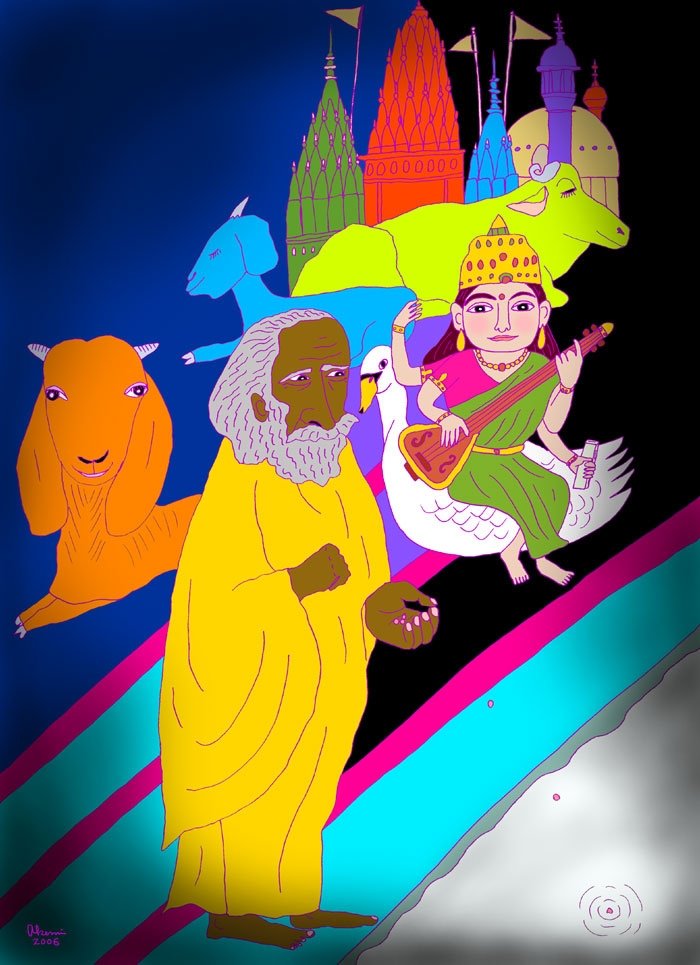
God speaks to Aunt Lucy.
Some of the things God has to say are very perceptive.
“Don’t you know?” “Don’t you know?” Aunt Lucy intones from a cloud of menthol smoke. “You’re all leprechauns.”
Some of the things God has to say are very perceptive.
“Don’t you know?” “Don’t you know?” Aunt Lucy intones from a cloud of menthol smoke. “You’re all leprechauns.”
Thursday, October 05, 2006
Family Travel / 15
Even if Aunt Gail did appear out of nowhere after 25 years, gentle as a ghost in the afternoon—I can’t very well ignore the rest of the family.
I have other aunts, after all, and no less noteworthy.
Aunt Lucy is my father’s sister. She spent most of her life in the state mental hospital. Now she lives in a halfway house but she always comes home for the holidays.
Aunt Lucy lost her mind half a century ago, her breasts and teeth more recently, and remains a singularly lovable person, body odor notwithstanding.
Aunt Lucy, who is admittedly a little musty, always wants a kiss, believes in lipstick and hand cream and menthol cigarettes. At holidays she could never sit still very long, she was up circumambulating the Thanksgiving feast, pausing to kiss our cheeks and mutter in our ears. . .
I have other aunts, after all, and no less noteworthy.
Aunt Lucy is my father’s sister. She spent most of her life in the state mental hospital. Now she lives in a halfway house but she always comes home for the holidays.
Aunt Lucy lost her mind half a century ago, her breasts and teeth more recently, and remains a singularly lovable person, body odor notwithstanding.
Aunt Lucy, who is admittedly a little musty, always wants a kiss, believes in lipstick and hand cream and menthol cigarettes. At holidays she could never sit still very long, she was up circumambulating the Thanksgiving feast, pausing to kiss our cheeks and mutter in our ears. . .
Wednesday, October 04, 2006
Family Travel / 14
Every year my cousin’s husband sends out a ten page single-spaced Christmas letter of prodigious honesty. The year before last was particularly awful. There were three deaths, two of them sudden, there were cancers and surgeries with lingering complications, as well as knee injuries and a house fire that nearly got out of hand.
Then, in November, their beloved Golden Lab Muttlee died of kidney failure at age 10.
God. I couldn’t help it. I laughed until tears streamed from my eyes.
Then, in November, their beloved Golden Lab Muttlee died of kidney failure at age 10.
God. I couldn’t help it. I laughed until tears streamed from my eyes.
Tuesday, October 03, 2006
Family Travel / 13
The night before my mother’s funeral I insisted on going trick-or-treating. Doubtless no one was in the mood to refuse me anything.
I was a ghost.
I got so much candy I could hardly walk.
I was a ghost.
I got so much candy I could hardly walk.
Family Travel / 12

I shared a room with the neighbor lady’s son. That night when the light was turned off I rolled over and told him, “My Mom died.”
He said, “Yeah, I know. My Mom told me.”
I remember lying there in the dark with my pal Chris and his cat with green eyes that shone in the dark and what I thought more than anything was that it was all incredibly interesting.
He said, “Yeah, I know. My Mom told me.”
I remember lying there in the dark with my pal Chris and his cat with green eyes that shone in the dark and what I thought more than anything was that it was all incredibly interesting.
Monday, October 02, 2006
Family Travel / 11
The neighbor lady took me into her parlor, sat me on the white sofa used only for guests, and told me my mother was dead.
I cried. I did the math. This leaves Dad, I thought. And cried some more.
Then I went back to the TV room and watched Halloween specials. Raggedy Ann and Andy. Someone was saving Halloween.
I cried. I did the math. This leaves Dad, I thought. And cried some more.
Then I went back to the TV room and watched Halloween specials. Raggedy Ann and Andy. Someone was saving Halloween.
Sunday, October 01, 2006
Family Travel / 10
A pacemaker, the doctors said, but when they opened her up there wasn’t enough heart muscle left and so my mother died on the operating table.
Saturday, September 30, 2006
Nagusami / 36
(Tokyo, 2006)
It’s 0:11 at Shinjuku’s South Exit and the skinny lovers are climbing the stairs hand-in-hand toward the ticket gates.
From the bridge just above I can see the glowing screens of their cellular phones and for once they seem like fireflies: the boys and girls have captured a glowing piece of ecstatic neon Shinjuku and are carrying it home carefully, cupped in their hands.
Midnight is the time of taking down. A helmeted blue suited guide waves traffic through with his uplifted flashing orange wand. Lovers draw their hands across each other cheeks from brow to neck.
I thought this was the hour of hurry and regret. There’s none of that. On a steel fence that encircles a single tree a young man and woman still sit, dangling their legs.
One big hair boy with a silver duffel tugs at his crotch. The clock’s immense minute hand moves forward one.
It’s 0:12 and they had fun and still were good. They are in time, will make it home tonight.
It’s 0:11 at Shinjuku’s South Exit and the skinny lovers are climbing the stairs hand-in-hand toward the ticket gates.
From the bridge just above I can see the glowing screens of their cellular phones and for once they seem like fireflies: the boys and girls have captured a glowing piece of ecstatic neon Shinjuku and are carrying it home carefully, cupped in their hands.
Midnight is the time of taking down. A helmeted blue suited guide waves traffic through with his uplifted flashing orange wand. Lovers draw their hands across each other cheeks from brow to neck.
I thought this was the hour of hurry and regret. There’s none of that. On a steel fence that encircles a single tree a young man and woman still sit, dangling their legs.
One big hair boy with a silver duffel tugs at his crotch. The clock’s immense minute hand moves forward one.
It’s 0:12 and they had fun and still were good. They are in time, will make it home tonight.
Friday, September 29, 2006
Family Travel / 9
No one refuses when I ask. “Of course. I’m happy to,” they say. “I’ll tell you all about your mother.”
Then they say, “Your mother was a wonderful cook.”
I get a menu. And that’s the end of it.
I was just about to meet my mother--she was in the next room--but she stepped out to the kitchen and left me staring at the food.
Then they say, “Your mother was a wonderful cook.”
I get a menu. And that’s the end of it.
I was just about to meet my mother--she was in the next room--but she stepped out to the kitchen and left me staring at the food.
Family Travel / 8
When I was a boy Aunt Gail wore her long salt and pepper hair up in an elegant bun. I remember I watched her combing it out one morning. Her hair reached nearly to her waist. I felt as though I’d had a revelation.
Tuesday, September 26, 2006
Family Travel / 7
Uncle Dan had been my father’s football coach and at eighty he still looked solid and vigorous. When he hugged me the tears in his eyes were magnified hugely by his coke-bottle glasses. My aunt, on the other hand, was very thin and looked so pale and dry that if you lifted her she'd weigh no more than hay. She’d had breast cancer, someone said. Maybe her mind was not what it once had been.
There wasn’t much to be said for me either. I’d been promising once and was no longer.
Here we were: trying to start again and so little left of us. Better not to try, I told myself. Still, I couldn’t help it: every time I looked at them the doors of my heart fell flying open.
There wasn’t much to be said for me either. I’d been promising once and was no longer.
Here we were: trying to start again and so little left of us. Better not to try, I told myself. Still, I couldn’t help it: every time I looked at them the doors of my heart fell flying open.
Monday, September 25, 2006
Nagusami / 35
Forgive me if you’ve heard this before. A few moments in any life are small durable flashlights to clutch against the pitch vast lurching dark.
In Banaras, around the time of the Sarasvati festival, I went walking alone on the ghats late at night. The steps of the ghats are steep and uneven and there are sudden drops. The riverfront, famed for its colors at dawn, is ghostly at night, lit only by an occasional cold floodlight from the old fort or ashram.
Walking down by the river, I saw someone standing wrapped in a blanket on the river’s edge. I couldn’t see much but I could hear him chant very slowly, in baritone, a name of God. At the end of each mantra he threw into the water what sounded like a tiny pebble.
I sat behind him on the stone steps, not too close, but near enough to be warmed by his voice chanting Sri Ram. . .Jai Ram. . .Jai Jai Ram. No other sounds but footsteps on stone faraway or, a few times, an oar in the water.
Finally, at the end of his devotions, the man turned around and saw the scrawny foreigner who’d huddled by his voice as by a fire. He smiled, showing his teeth in the dark and held his hand out to me. His cupped palm still held a few tiny pieces of sugar candy.
His voice was quiet and certain. He said, “It is important work-fish-feeding.”
In Banaras, around the time of the Sarasvati festival, I went walking alone on the ghats late at night. The steps of the ghats are steep and uneven and there are sudden drops. The riverfront, famed for its colors at dawn, is ghostly at night, lit only by an occasional cold floodlight from the old fort or ashram.
Walking down by the river, I saw someone standing wrapped in a blanket on the river’s edge. I couldn’t see much but I could hear him chant very slowly, in baritone, a name of God. At the end of each mantra he threw into the water what sounded like a tiny pebble.
I sat behind him on the stone steps, not too close, but near enough to be warmed by his voice chanting Sri Ram. . .Jai Ram. . .Jai Jai Ram. No other sounds but footsteps on stone faraway or, a few times, an oar in the water.
Finally, at the end of his devotions, the man turned around and saw the scrawny foreigner who’d huddled by his voice as by a fire. He smiled, showing his teeth in the dark and held his hand out to me. His cupped palm still held a few tiny pieces of sugar candy.
His voice was quiet and certain. He said, “It is important work-fish-feeding.”
Sunday, September 24, 2006
Nagusami / 34
Mary, of course, was not her real name. She told her real name once, to a visiting missionary, and Ebenezer beat her for it and the missionary forgot the name.
Mary shouldn’t be talking. Mary ought to be scrubbing the floor, sorting the rice, cooking chapatti over the kerosene fire.
At night Mary coughed, an awful cough that shook the house. She’d been dying in her village when Ebenezer came huffing and puffing down the bicycle path because his old Ambassador car couldn’t squeeze through.
Mary, the village tomato lady, was taken to Hyderabad and in return it was only fair that she should serve Ebenezer in his kitchen and in his bed.
Mary did talk however and even learned a little English from the visiting missionaries and hearing Ebenezer talk to the charity money men.
Of course she made some mistakes. For example, she never learned that hungry and angry were two separate words. If you were ‘hangry’ she immediately brought dhal and chapattis.
This particular mistake proved never to be an obstacle.
She said, “You like me. I like you. You no like me. I no like you.”
She even taught a little of her language to the visiting missionary who couldn’t be expected to remember. One night on the roof of the house in Hyderabad where she was prisoner she lifted her hands to the full moon and instructed,
Chan-dha Ma-ma Ra-vay!
Moon Mother, Come!
Mary shouldn’t be talking. Mary ought to be scrubbing the floor, sorting the rice, cooking chapatti over the kerosene fire.
At night Mary coughed, an awful cough that shook the house. She’d been dying in her village when Ebenezer came huffing and puffing down the bicycle path because his old Ambassador car couldn’t squeeze through.
Mary, the village tomato lady, was taken to Hyderabad and in return it was only fair that she should serve Ebenezer in his kitchen and in his bed.
Mary did talk however and even learned a little English from the visiting missionaries and hearing Ebenezer talk to the charity money men.
Of course she made some mistakes. For example, she never learned that hungry and angry were two separate words. If you were ‘hangry’ she immediately brought dhal and chapattis.
This particular mistake proved never to be an obstacle.
She said, “You like me. I like you. You no like me. I no like you.”
She even taught a little of her language to the visiting missionary who couldn’t be expected to remember. One night on the roof of the house in Hyderabad where she was prisoner she lifted her hands to the full moon and instructed,
Chan-dha Ma-ma Ra-vay!
Moon Mother, Come!
Saturday, September 23, 2006
Nagusami / 33
Those who went into these “bad places” entered an intoxicating, out-of-the-ordinary, festival-like world where the line between reality and dream was blurred.
--Haruo Shirane
(Phuket, 2005)
So cautiously, so gingerly, he pushed open the gray anonymous door -
Hey sexy!
Two dozen big boys under black lights in white spandex laughing waving to him from the stage.
Well. There wasn’t really any choice, was there now, but to go in?
--Haruo Shirane
(Phuket, 2005)
So cautiously, so gingerly, he pushed open the gray anonymous door -
Hey sexy!
Two dozen big boys under black lights in white spandex laughing waving to him from the stage.
Well. There wasn’t really any choice, was there now, but to go in?
Friday, September 22, 2006
Family Travel / 6
Aunt Gail and Uncle Dan were both eighty but they said, “No, we’ll come to you” and drove all the way down from Maine. We arranged folding chairs in the backyard of the farmhouse and my sister-in-law made a big breakfast. My uncle and aunt brought a huge tray of scones and fancy pastries from a bakery in Portland. It was downright strange, the amount of food we had. We all thanked each other warmly for the very generous pastries, the thoughtful eggs and fried potatoes.
We arranged our plates and laid our forks by them. Nobody ate anything.
We arranged our plates and laid our forks by them. Nobody ate anything.
Wednesday, September 20, 2006
Family Travel / 5
I asked my father once if Mom ever talked about dying.
“Your mother didn’t think like that,” he said. “She hoped for the best.”
About this, it turns out, my father was wrong.
“Your mother didn’t think like that,” he said. “She hoped for the best.”
About this, it turns out, my father was wrong.
Tuesday, September 19, 2006
Family Travel / 4
The last Mother’s Day my mother was alive my father planted a blue spruce in the backyard as my mother watched from the laundry room window. Twenty five years later, that fragrant tree, taller than the house, towers over the yard.
Monday, September 18, 2006
Family Travel / 3
It’s the same story my father always tells, of Grandma Grace’s trip around the world, except this time it starts “After your great-grandmother drowned herself in the pond out back. . .” And my brothers and I have to flag Dad down, as he sits by the fireplace in the kitchen. “You never told us that!” “Didn’t I?” Dad says. ”Breast cancer, I think. She didn’t want to go through with it.”
This is a matter of pride in my family. We never kill ourselves without a real good reason. How many times have I heard the story of my grandmother going round the world at age 17? I never knew that drowning was the starting point--that grief filled the sails.
Grandma Grace went round the world in 1926. And she came home to the farm and the farm and the farm.
“She was like living with a movie star,” my father says. “Glamorous, and not exactly there.” Swears he seldom saw her drink.
My great-grandmother chose drowning. My grandmother chose a gun. Forty years later, my father sat in the kitchen, opened his hands and said, “My poor Mother. We should have just let her go.”
This is a matter of pride in my family. We never kill ourselves without a real good reason. How many times have I heard the story of my grandmother going round the world at age 17? I never knew that drowning was the starting point--that grief filled the sails.
Grandma Grace went round the world in 1926. And she came home to the farm and the farm and the farm.
“She was like living with a movie star,” my father says. “Glamorous, and not exactly there.” Swears he seldom saw her drink.
My great-grandmother chose drowning. My grandmother chose a gun. Forty years later, my father sat in the kitchen, opened his hands and said, “My poor Mother. We should have just let her go.”
Sunday, September 17, 2006
Family Travel / 2
Don’t you love family reunions? Everyone gets to meet everyone.
For example, I get to introduce my mother’s sister, vanished 25 years, to my mother’s namesake, my niece, who is 20 years old, seven months pregnant, due to be shipped to Iraq 45 days after the birth, and looking plenty shell-shocked already.
Does this sound like fun?
Right at the start I’d like to sit the family down, hand out stubby yellow pencils, and make the following announcement. “You may NOT talk. The following is a list of explanations and guidelines. You may take notes. You may not interrupt. There will be time for questions at the end.”
This is impossible, of course, because no one could agree on an official version—or the official version would have nothing to do with the truth.
All I said was, “Joan is Ned’s second wife” and immediately Ned is fidgeting. Evidently Joan is actually the third. There was another mystery wife sandwiched briefly in the middle. We don’t talk about her.
Finally nothing can be said but, “Everyone does just love Uncle Ned!”
For example, I get to introduce my mother’s sister, vanished 25 years, to my mother’s namesake, my niece, who is 20 years old, seven months pregnant, due to be shipped to Iraq 45 days after the birth, and looking plenty shell-shocked already.
Does this sound like fun?
Right at the start I’d like to sit the family down, hand out stubby yellow pencils, and make the following announcement. “You may NOT talk. The following is a list of explanations and guidelines. You may take notes. You may not interrupt. There will be time for questions at the end.”
This is impossible, of course, because no one could agree on an official version—or the official version would have nothing to do with the truth.
All I said was, “Joan is Ned’s second wife” and immediately Ned is fidgeting. Evidently Joan is actually the third. There was another mystery wife sandwiched briefly in the middle. We don’t talk about her.
Finally nothing can be said but, “Everyone does just love Uncle Ned!”
Saturday, September 16, 2006
Family Travel / 1
When my aunt came back after twenty five years she gave me a plastic rock. The kind people hide keys in, except there wasn’t a key. Gale, the aunt I was sure I’d never see again: here she was. She was fragile and pale; she’d grown old. She kept forgetting which one was my husband and which one was my brother. Still, when everyone else had been led away and it was just the two of us she grew determined. “I have something to tell you,” she said. “You can throw the rock any time you want to.”
Family Travel, disclaimer
Although many parallels exist between the following text and the life of its writer, the following should be seen as a fiction. No family's history can fairly be told from a single vantage point. Others would no doubt tell a radically different story.
I write the following goaded by the the Gospel of Thomas: "If you bring forth what is within you, what you bring forth will save you. If you do not bring forth what is within you, what you do not bring forth will destroy you."
I write the following goaded by the the Gospel of Thomas: "If you bring forth what is within you, what you bring forth will save you. If you do not bring forth what is within you, what you do not bring forth will destroy you."
Tuesday, September 12, 2006

Dream: Merry-Go Yamanote
I dreamt I rode a wooden horse, as from an old-fashioned merry-go-round, colorful and smooth from a century's worth of shellac.
I rode that horse and the horse was hooked to the back of the Yamanote Line train.
"Well, this is new!" I thought when I saw that horse and I climbed right on.
The Yamanote line train circles central Tokyo at high speed, speeds especially fast if you're flying through windy tunnels trying to keep a grip on a wooden horse. There was nothing to hold onto; the horse was so smooth I was sure I'd slide right off onto the tracks.
Finally, the train stopped at Ebisu. "This is appallingly dangerous," I thought. "I should get off here." But I hated back-tracking and, anyway, I was already late.
Two old obasan hurried up to me then. "You've got to put your feet in the stirrups!" They didn't wait for me, but each grabbed a foot and stuck it into a stirrup.
In another second I was off again, my bright horse chasing the Yamanote Line train.
I rode that horse and the horse was hooked to the back of the Yamanote Line train.
"Well, this is new!" I thought when I saw that horse and I climbed right on.
The Yamanote line train circles central Tokyo at high speed, speeds especially fast if you're flying through windy tunnels trying to keep a grip on a wooden horse. There was nothing to hold onto; the horse was so smooth I was sure I'd slide right off onto the tracks.
Finally, the train stopped at Ebisu. "This is appallingly dangerous," I thought. "I should get off here." But I hated back-tracking and, anyway, I was already late.
Two old obasan hurried up to me then. "You've got to put your feet in the stirrups!" They didn't wait for me, but each grabbed a foot and stuck it into a stirrup.
In another second I was off again, my bright horse chasing the Yamanote Line train.
Friday, September 08, 2006
Sermon for September 8th
The good news is: your thoughts are not plutonium. Only shit.
Remember this when asked to call to mind the essential purity of mind, which remains untouched by all contaminants, like the earth, the ocean or the wind—
No, wait. All those things are thoroughly sullied. The poisons sunk deep even into the metaphors.
Imagine then, something beyond the bright, beyond secret prisons and ozone, beyond presidential decree, something so vast hidden in the breath, including even the nebulae, the neutrons, ions and Republicans, embracing even ever-radiant you, and your shitty little thoughts.
Remember this when asked to call to mind the essential purity of mind, which remains untouched by all contaminants, like the earth, the ocean or the wind—
No, wait. All those things are thoroughly sullied. The poisons sunk deep even into the metaphors.
Imagine then, something beyond the bright, beyond secret prisons and ozone, beyond presidential decree, something so vast hidden in the breath, including even the nebulae, the neutrons, ions and Republicans, embracing even ever-radiant you, and your shitty little thoughts.
Thursday, September 07, 2006
Nagusami / 32
(Tokyo, 2006)
I’d like a street-smart master, rather than the pious rural model—the sort of guru who might accost one at a late-night coin laundromat. I’d bring that guru beer instead of marigolds, food stamps instead of the pious envelope of cash.
I worry the first thing that guru'd do, if my master ever deigned to appear in Tokyo, is make me give up my special space on the train, the standing space in the nook just beside the door. On the train with the rush hour crowd, ass against the wall, that space makes it all much easier to bear.
I’ve become expert at darting to that space, un-tempted by the slim chance of a seat, expert at beating out any short woman or elderly person who might also covet that slightly protected space beside the door. In the middle of the train you’re jostled by people getting in or out; in the corner you can turn to stone. In my safe corner I hunker down and just endure--keep an eye out for unsettling city masters, the troublemakers who say there’s more to it than just keeping yourself protected and near the exit.
I’d like a street-smart master, rather than the pious rural model—the sort of guru who might accost one at a late-night coin laundromat. I’d bring that guru beer instead of marigolds, food stamps instead of the pious envelope of cash.
I worry the first thing that guru'd do, if my master ever deigned to appear in Tokyo, is make me give up my special space on the train, the standing space in the nook just beside the door. On the train with the rush hour crowd, ass against the wall, that space makes it all much easier to bear.
I’ve become expert at darting to that space, un-tempted by the slim chance of a seat, expert at beating out any short woman or elderly person who might also covet that slightly protected space beside the door. In the middle of the train you’re jostled by people getting in or out; in the corner you can turn to stone. In my safe corner I hunker down and just endure--keep an eye out for unsettling city masters, the troublemakers who say there’s more to it than just keeping yourself protected and near the exit.
Wednesday, September 06, 2006
Nagusami / 31
The bakufu, whose first priority was to uphold the social order and public security, designated the “bad places” as spaces of controlled release (nagusami), where citizens’ excess energy could be channeled and where it was understood that there would be no criticism of the existing order. -- Haruo Shirane, Early Modern Japanese Literature 1600 – 1900
The trouble, of course, is in the phrase “no criticism of the existing order.” As if we might wile away our time in nagusami while the president completes the destruction of the globe.
Instead what we aim for is sustenance in small packages. To sustain life with tiny barely noticeable gestures.
Turn the page with your one beautiful leisurely hand, while the other is handcuffed to the gate of the weapons manufacturer. Here’s a little something to read--while you wait for your case to come to trial.
Continue the heroics. We are pleased to serve sandwiches.
The trouble, of course, is in the phrase “no criticism of the existing order.” As if we might wile away our time in nagusami while the president completes the destruction of the globe.
Instead what we aim for is sustenance in small packages. To sustain life with tiny barely noticeable gestures.
Turn the page with your one beautiful leisurely hand, while the other is handcuffed to the gate of the weapons manufacturer. Here’s a little something to read--while you wait for your case to come to trial.
Continue the heroics. We are pleased to serve sandwiches.
Monday, September 04, 2006
A safe place.
Then there’s the very particular hell of losing something. For example, a very important piece of paper, which you can neither find nor stop looking for. Immediately one’s apartment, which seemed such a modest space, is revealed to be a vast and craggy wilderness, an Afghanistan, with countless hiding places. Where could it be? In this file, on this shelf, in this drawer—or behind it, or under it, or near. It can’t be nowhere, dammit. Things don’t just disappear.
Funny, how you never realized your life was completely out of control until now.
Consider the time you are wasting. This was your special hour to be creative. This was your own special time, which gets you through the day and its hassles. You were almost out the door and right on schedule. Ready to reconnect with the children.
The children. Whatever happened to them?
Anyway, the chance is lost because you won’t rest until you find that very important (and unfortunately, quite small) thing which you have lost. Inside you a thin insistent voice is needling, “It can’t be lost. I’m sure it’s right here. Somewhere. I put it in a safe place.” That voice is inside you. Therefore, it is impossible to murder it without wide-ranging consequences. Still, you will try. But first—you must find what you are looking for.
In the meantime, you find all the unpaid bills, the unread books and unanswered letters. All your abandoned projects and pictures of all the people you promised, tearfully, to write, call, visit and find time for.
Hey, you aren’t using your life well, are you? Life is passing you by. All your time is wasted with pointless tasks. Like now.
And you can just see it. You can see it—that’s how perfectly you can picture it in your mind. You ought to be able to draw it right out of the air, you can see it so well. It ought to be right—here.
You look in the same place for the fifth time. Because it’s got to be here. But it’s not. And the blaze of relief—and the vicious stabbing pike of --no, this isn’t it. This only looks like it. The world is full of these near-miss doppelgangers, sent by God to punish you for your misspent life.
What a wreck you’ve made of it, considering all the wonderful chances you were given. People had such hopes for you. You were promising, once.
Now you only waste your time in countless bad habits and looking for this small, terribly important, thing which you have lost.
Except it isn’t lost. It can’t be. Things don’t just disappear.
It’s here. It’s got to be. You put it someplace safe.
Funny, how you never realized your life was completely out of control until now.
Consider the time you are wasting. This was your special hour to be creative. This was your own special time, which gets you through the day and its hassles. You were almost out the door and right on schedule. Ready to reconnect with the children.
The children. Whatever happened to them?
Anyway, the chance is lost because you won’t rest until you find that very important (and unfortunately, quite small) thing which you have lost. Inside you a thin insistent voice is needling, “It can’t be lost. I’m sure it’s right here. Somewhere. I put it in a safe place.” That voice is inside you. Therefore, it is impossible to murder it without wide-ranging consequences. Still, you will try. But first—you must find what you are looking for.
In the meantime, you find all the unpaid bills, the unread books and unanswered letters. All your abandoned projects and pictures of all the people you promised, tearfully, to write, call, visit and find time for.
Hey, you aren’t using your life well, are you? Life is passing you by. All your time is wasted with pointless tasks. Like now.
And you can just see it. You can see it—that’s how perfectly you can picture it in your mind. You ought to be able to draw it right out of the air, you can see it so well. It ought to be right—here.
You look in the same place for the fifth time. Because it’s got to be here. But it’s not. And the blaze of relief—and the vicious stabbing pike of --no, this isn’t it. This only looks like it. The world is full of these near-miss doppelgangers, sent by God to punish you for your misspent life.
What a wreck you’ve made of it, considering all the wonderful chances you were given. People had such hopes for you. You were promising, once.
Now you only waste your time in countless bad habits and looking for this small, terribly important, thing which you have lost.
Except it isn’t lost. It can’t be. Things don’t just disappear.
It’s here. It’s got to be. You put it someplace safe.
Sunday, September 03, 2006
A glass wall.
My brother took me to airport. We hadn’t had a chance to talk. We didn’t talk in the car either. Not really. We said goodbye at the check-in counter but he didn’t leave right away, he waited, and I turned and waved to him from the other side of security.
He waved back. I missed him already.
I turned and walked down the corridor toward the gate, already thinking, what’s next, when I glanced to the side and saw him right beside me, silenced by a wall of glass. Surprise! He was waving, clowning from the other side of the wall. He was saying something; I couldn’t tell what it was. How sweet of him, my brother whom everyone loves, the drunk.
I hardly got to see him anymore. Not like this. The whole visit he’d been hunched over the table, sarcastic, waiting for whatever it was to be over.
My brother, the same one who taught me to love the forest.
Now he believed, or said he believed, every word the president said. The attacks didn’t make him like this. He’d been becoming this all along. September 11th just made it official, official justification to be afraid and angry.
My brother used to rescue birds. He even kissed me once, right on the top of my head.
My brother has always been taller than me, and better looking.
My big brother on the other side of the glass. His face open and warm like I’d remembered. How sweet of him to do this. How like him.
I should have said goodbye at the curb, I thought. This is going to kill me.
He was right there, walking right beside me as I walked down the hall. I didn’t know what he was saying. He was laughing.
I walked as fast as I could and tried to seem reluctant.
The glass was ending ahead. I waved with both hands. So did he. My brother, who is taller than me and better looking and always will be.
How horrible these glass walls are. To be so close and not able to be heard or to touch. I can’t imagine I’ll be able to look at one now, whether arriving or departing, without wanting to scream.
How childish. To be as old as I am now--and still sprouting new fears.
He waved back. I missed him already.
I turned and walked down the corridor toward the gate, already thinking, what’s next, when I glanced to the side and saw him right beside me, silenced by a wall of glass. Surprise! He was waving, clowning from the other side of the wall. He was saying something; I couldn’t tell what it was. How sweet of him, my brother whom everyone loves, the drunk.
I hardly got to see him anymore. Not like this. The whole visit he’d been hunched over the table, sarcastic, waiting for whatever it was to be over.
My brother, the same one who taught me to love the forest.
Now he believed, or said he believed, every word the president said. The attacks didn’t make him like this. He’d been becoming this all along. September 11th just made it official, official justification to be afraid and angry.
My brother used to rescue birds. He even kissed me once, right on the top of my head.
My brother has always been taller than me, and better looking.
My big brother on the other side of the glass. His face open and warm like I’d remembered. How sweet of him to do this. How like him.
I should have said goodbye at the curb, I thought. This is going to kill me.
He was right there, walking right beside me as I walked down the hall. I didn’t know what he was saying. He was laughing.
I walked as fast as I could and tried to seem reluctant.
The glass was ending ahead. I waved with both hands. So did he. My brother, who is taller than me and better looking and always will be.
How horrible these glass walls are. To be so close and not able to be heard or to touch. I can’t imagine I’ll be able to look at one now, whether arriving or departing, without wanting to scream.
How childish. To be as old as I am now--and still sprouting new fears.
Saturday, September 02, 2006
Nagusami / 30
The trick of freedom, when at last you get a little, is not to go completely fucking nuts and singlemindedly obliterate yourself. Like the coal miners who work twelve hours a day, six days a week. Who can blame them if, on the seventh day, they start getting drunk at dawn? Still, one must avoid this if one can. We are unaccustomed to freedom, as ascetics are unaccustomed to eating, and must break our fast carefully, starting with clear broth.
Friday, September 01, 2006

The chairs.
First-time visitors to the attic are amazed but let me tell you it’s nothing like it was. The pockets and pickup trucks of a century’s lovers and brothers and well-wishers have taken almost everything away. I’m guilty too. From the attic I once took an old letter in blue ink that told of a great-grandfather’s journey around Cape Horn. I lost it before I’d even read it to the end.
Even when I was a boy there was still a stuffed alligator and Civil War uniforms with locks of hair in their pockets. Most of what’s in the attic now is junk, and not so old at that.
For example, there is a collection of chairs that fills an entire room, chairs in dilapidated rows, piled on top of each other, with a few even dangling from the rafters. The chairs that wait all day to receive the sun that filters through the ancient curtains in the late afternoon. Why do we have all these chairs?
The motive cannot be thrift or preparedness. No matter how outrageous the party, no one is ever going to say, “Honey, could you run up to the attic and get another hundred chairs?”
My family has lost everything, as every family does—it just appears that we have never lost a chair.
And it’s the usual trouble: the chairs were granted immortality but not youth. Most withdrew to the attic in sad disrepair and there is hardly any place you’d dare sit, even tentatively. Even the ghosts (honestly, who else could all these chairs be for?) must go crashing to the floor during particularly raucous committee meetings.
The chairs are just intact enough for memory, but most of the memories have long since been dismantled.
The chairs I know are toward the front. The heavy rounded chairs of when my brother’s children still lived at home. Chairs that only did their job and didn’t care for fashion.
The spindly chairs of my father’s aristocratic revivals are next. They didn’t last long. And then there are my mother’s chairs, the chairs I sat in as a boy. Mismatched chairs made from good wood, a little soft, that I dug my nails in.
Chairs, thank God, aren’t much good for moral admonitions, can’t manage more than a doleful: he leaned back!
Even the highchair my father made is here. A highchair with gothic arches and a letter in the seat. A very pompous high chair, really. Like a throne. No wonder we put on such airs.
How little I know of the chairs. Most of them I don’t recognize. The chairs further back are curious and dour. They seem to possess some occult geometric power, so that it seems they might, if returned to their past configuration, call back the people who once sat downstairs around the table. Perhaps, if I crawled back and sat, I might see my great-grandmother leaning toward me with a ladle full of soup. Or my mother--.
The chairs are here for us. We do not dare.
We ought to call up Mr. Conrad, the appraiser. These old chairs might be worth something.
Isn’t it a relief to know that even in this world there are a few things are guaranteed not to happen? For example, no one between the end of time will ever mend these chairs. Even if one is a pre-Victorian cherry deluxe et cetera, no one will make a dime off these chairs.
They will remain, keeping time in rows, and not forever. Only until the fire.
Even when I was a boy there was still a stuffed alligator and Civil War uniforms with locks of hair in their pockets. Most of what’s in the attic now is junk, and not so old at that.
For example, there is a collection of chairs that fills an entire room, chairs in dilapidated rows, piled on top of each other, with a few even dangling from the rafters. The chairs that wait all day to receive the sun that filters through the ancient curtains in the late afternoon. Why do we have all these chairs?
The motive cannot be thrift or preparedness. No matter how outrageous the party, no one is ever going to say, “Honey, could you run up to the attic and get another hundred chairs?”
My family has lost everything, as every family does—it just appears that we have never lost a chair.
And it’s the usual trouble: the chairs were granted immortality but not youth. Most withdrew to the attic in sad disrepair and there is hardly any place you’d dare sit, even tentatively. Even the ghosts (honestly, who else could all these chairs be for?) must go crashing to the floor during particularly raucous committee meetings.
The chairs are just intact enough for memory, but most of the memories have long since been dismantled.
The chairs I know are toward the front. The heavy rounded chairs of when my brother’s children still lived at home. Chairs that only did their job and didn’t care for fashion.
The spindly chairs of my father’s aristocratic revivals are next. They didn’t last long. And then there are my mother’s chairs, the chairs I sat in as a boy. Mismatched chairs made from good wood, a little soft, that I dug my nails in.
Chairs, thank God, aren’t much good for moral admonitions, can’t manage more than a doleful: he leaned back!
Even the highchair my father made is here. A highchair with gothic arches and a letter in the seat. A very pompous high chair, really. Like a throne. No wonder we put on such airs.
How little I know of the chairs. Most of them I don’t recognize. The chairs further back are curious and dour. They seem to possess some occult geometric power, so that it seems they might, if returned to their past configuration, call back the people who once sat downstairs around the table. Perhaps, if I crawled back and sat, I might see my great-grandmother leaning toward me with a ladle full of soup. Or my mother--.
The chairs are here for us. We do not dare.
We ought to call up Mr. Conrad, the appraiser. These old chairs might be worth something.
Isn’t it a relief to know that even in this world there are a few things are guaranteed not to happen? For example, no one between the end of time will ever mend these chairs. Even if one is a pre-Victorian cherry deluxe et cetera, no one will make a dime off these chairs.
They will remain, keeping time in rows, and not forever. Only until the fire.
Nagusami / 29
Sometimes when I spend time with the muscled-up, well-moisturized, well-to-do white men who constitute what is known as ‘gay’ I consider renouncing the phenomenon known as ‘gay’ and embracing a lifestyle not so fixed and set in its rules and prohibitions, something more relaxed. For example, fundamentalist Islam.
Wednesday, August 30, 2006
Nagusami / 28
(Bangkok, 2006)
Babylon: a homosexual hell/heaven providing the affluent queer with all his needs. And the first necessity is the opportunity to reject each other, with maximum disdain, at every moment. A simple turn of the head—I will not acknowledge you—is sufficient, though the place is crowded enough that the men must sway their heads from side to side constantly to avoid each other’s glance.
There is more looking away than looking. The occasional accident is bizarre. Two men, determined to ignore each other, collide. Men walk into walls.
Potted palms, placed throughout the complex, receive great attention. Only the palms can safely be looked at. Beautiful men fix them with hard stares while eating their fruit-laden breakfasts and ignoring each other.
As you can imagine, those potted palms have become quite puffed up and arrogant from all the attention. They consider themselves enormous, those potted palms. Positively towering.
Babylon: a homosexual hell/heaven providing the affluent queer with all his needs. And the first necessity is the opportunity to reject each other, with maximum disdain, at every moment. A simple turn of the head—I will not acknowledge you—is sufficient, though the place is crowded enough that the men must sway their heads from side to side constantly to avoid each other’s glance.
There is more looking away than looking. The occasional accident is bizarre. Two men, determined to ignore each other, collide. Men walk into walls.
Potted palms, placed throughout the complex, receive great attention. Only the palms can safely be looked at. Beautiful men fix them with hard stares while eating their fruit-laden breakfasts and ignoring each other.
As you can imagine, those potted palms have become quite puffed up and arrogant from all the attention. They consider themselves enormous, those potted palms. Positively towering.
Tuesday, August 29, 2006
Nagusami / 27
(Bangkok, 2006)
Four hundred years ago in Edo the bakufu built walled cities within cities to house the pleasure quarters. Now, when the prosperous queers of Tokyo want space plus permission, they go to Bangkok, to the Babylon. Surrounded by stone in the diplomatic enclave as if it were the Babylonian Embassy. It might as well be—an outpost of queer permission and excess in Asia.
Begin in the middle: a long blue pool, the only place where the management requests you, please, wear clothes. Twin sphinxes crouch at one end and the perimeter is all palms and flowering trees but you never see a flower fallen into the pool. Facing the pool are two high glass walls which contain a gleaming mirrored gym and an elegant restaurant with the photos of black and white American movie stars on the seat backs. If you’re dining I recommend the duck and there’s a woman who sings soul in the evenings, the only woman permitted in the whole establishment, beside the two gorgeous post-op ladyboys who take your money at the door.
On the opposite side of that restaurant—both walls are glass—is an open courtyard with a bar and two towering Egyptians with tasteful Art Deco penises who preside over the men in towels and their evening cocktails. Everything is tasteful and elegant, from the stenciled menus to the monsoon clouds overhead. And a man may do exactly as he likes.
The trouble in this Heaven is the usual one: our paradise runs ahead of us and leaves us in our accustomed dust. We are not ready for it.
The management has made allowances for this and so, from every garden, every courtyard, tunnels extend with all the dim passages and dark corners to which we are habituated. This is what we’re here for: to chase each other in the near dark. Men are still visible, their age obscured, in the tiled wet area where the halls empty into steamrooms, darker still, and showers with curved walls. Down a metal spiral staircase there’s a basement for men who desire more darkness. Of course there is corridor after corridor of individual cubicles with doors that lock and each one comes with a dimming switch so that you may decide how much light you can endure. It’s part of the routine of sex between strangers. One man turns up the light, the other dims it down again.
We do as we like and try not to see too much of it.
To first-time visitors, the corridors seem infinite. Later, that feeling fades. Still, the maze is large enough so that, going through it once, you’re sure there's someone you’ve missed and you circle back through again.
Babylon, with its vast decorated shell and the damp curved walls of its spiraling interior is exactly like an gigantic mollusc and the dark animal, mysterious and vulnerable, that fills every corner within is called desire.
Four hundred years ago in Edo the bakufu built walled cities within cities to house the pleasure quarters. Now, when the prosperous queers of Tokyo want space plus permission, they go to Bangkok, to the Babylon. Surrounded by stone in the diplomatic enclave as if it were the Babylonian Embassy. It might as well be—an outpost of queer permission and excess in Asia.
Begin in the middle: a long blue pool, the only place where the management requests you, please, wear clothes. Twin sphinxes crouch at one end and the perimeter is all palms and flowering trees but you never see a flower fallen into the pool. Facing the pool are two high glass walls which contain a gleaming mirrored gym and an elegant restaurant with the photos of black and white American movie stars on the seat backs. If you’re dining I recommend the duck and there’s a woman who sings soul in the evenings, the only woman permitted in the whole establishment, beside the two gorgeous post-op ladyboys who take your money at the door.
On the opposite side of that restaurant—both walls are glass—is an open courtyard with a bar and two towering Egyptians with tasteful Art Deco penises who preside over the men in towels and their evening cocktails. Everything is tasteful and elegant, from the stenciled menus to the monsoon clouds overhead. And a man may do exactly as he likes.
The trouble in this Heaven is the usual one: our paradise runs ahead of us and leaves us in our accustomed dust. We are not ready for it.
The management has made allowances for this and so, from every garden, every courtyard, tunnels extend with all the dim passages and dark corners to which we are habituated. This is what we’re here for: to chase each other in the near dark. Men are still visible, their age obscured, in the tiled wet area where the halls empty into steamrooms, darker still, and showers with curved walls. Down a metal spiral staircase there’s a basement for men who desire more darkness. Of course there is corridor after corridor of individual cubicles with doors that lock and each one comes with a dimming switch so that you may decide how much light you can endure. It’s part of the routine of sex between strangers. One man turns up the light, the other dims it down again.
We do as we like and try not to see too much of it.
To first-time visitors, the corridors seem infinite. Later, that feeling fades. Still, the maze is large enough so that, going through it once, you’re sure there's someone you’ve missed and you circle back through again.
Babylon, with its vast decorated shell and the damp curved walls of its spiraling interior is exactly like an gigantic mollusc and the dark animal, mysterious and vulnerable, that fills every corner within is called desire.
Monday, August 28, 2006

Nagusami / 26
Happiness is elusive and when it shows up it’s peculiar – that quirky friend of yours you always want to get together with but (dammit!) she’s so hard to pin down. When she finally appears – you were just about to leave – it doesn’t matter if dinner’s slow, if your nose is runny – everything makes you want to laugh and say, isn’t that absurd?
Why am I happy? Because my muscle shirt matches exactly the purple upholstery of Singapore Airlines. My hair is chopped short and my muscles are bulging. It’s all a little obvious and overdone. I’m a soldier in the international sex army. (By now have I acquired rank?) Call us! We’ll solve your conflicts!
Why am I happy? Because my muscle shirt matches exactly the purple upholstery of Singapore Airlines. My hair is chopped short and my muscles are bulging. It’s all a little obvious and overdone. I’m a soldier in the international sex army. (By now have I acquired rank?) Call us! We’ll solve your conflicts!
Nagusami / 25
At Narita Airport I volunteered to be moved to a later flight in exchange for a free ticket. And it was as if I had become a ghost, wafting backward through immigration, past the guards, and out to an immense featureless airport hotel.
The hotel’s lobby, I was pleased to see, was actually quite impressive: a marble counter, a huge bouquet of lilies, smiling ladies in immaculate suits. I was waiting in line when a man called my name and waved me over to the far right side of the lobby which, I discovered, was dim and grubby, set up with rickety wooden tables, stubby pencils and forms, exactly like an unemployment office. Even the counter at this edge was smudged and coated with plastic.
From this edge, looking back at the flowers and the smiling ladies was like looking back into another world. I was not offended; it seemed to me they must have gone to great trouble to make the difference so stark. I kept my composure. I suspect the afterlife will be just like this. Ah, you’ve just arrived? Please step aside.
The hotel’s lobby, I was pleased to see, was actually quite impressive: a marble counter, a huge bouquet of lilies, smiling ladies in immaculate suits. I was waiting in line when a man called my name and waved me over to the far right side of the lobby which, I discovered, was dim and grubby, set up with rickety wooden tables, stubby pencils and forms, exactly like an unemployment office. Even the counter at this edge was smudged and coated with plastic.
From this edge, looking back at the flowers and the smiling ladies was like looking back into another world. I was not offended; it seemed to me they must have gone to great trouble to make the difference so stark. I kept my composure. I suspect the afterlife will be just like this. Ah, you’ve just arrived? Please step aside.
Sunday, August 27, 2006

Nagusami / 24
Few books are willing to go anywhere. Some insist on cappuccinno and a snazzy café, some call out for beer, others rarely venture out of the classroom. What we’re looking for is a book that will accompany one without wincing or shrinking and provide good company anywhere, whether one is waiting one’s turn at a public sexually transmitted disease clinic or savoring a spare solitary moment in the cathedral at Chartres.
I am forever in search of inspirational reading that does not require, as a prerequisite, virtue.
Some suggestions: Stories by Kawabata Yasunari or Lucia Berlin. Tibetan Seven Point Mind Training. De Caussade’s Abandonment to Divine Providence. Richardson's biography of Thoreau, Sei Shonagon’s Pillow Book. Baudelaire’s Paris Spleen.
Please send your additions.
I am forever in search of inspirational reading that does not require, as a prerequisite, virtue.
Some suggestions: Stories by Kawabata Yasunari or Lucia Berlin. Tibetan Seven Point Mind Training. De Caussade’s Abandonment to Divine Providence. Richardson's biography of Thoreau, Sei Shonagon’s Pillow Book. Baudelaire’s Paris Spleen.
Please send your additions.
Saturday, August 26, 2006
Nagusami / 23
Happiness is inversely proportional to luggage. There’s no skirting this rule, little wheels don’t count, it is exact. One blue backpack, smudged with countries and only half full. Packing is a joy if seen primarily as a process of exclusion. “I’m not taking that! I’m not taking that either! Oh no, all that’s staying here!”
What’s left are primarily magical talismans, the only necessities for a real journey. Notebook, prayer beads, devotional pictures, condoms and lube, exactly the right book to read.
What’s left are primarily magical talismans, the only necessities for a real journey. Notebook, prayer beads, devotional pictures, condoms and lube, exactly the right book to read.
Nagusami / 22
Triumph of the lightheart: departure day. As if I held a winning ticket, or found my cock had grown three bonus inches overnight. As if I'd been granted a room entirely my own with a broad sturdy table and silence and natural light.
None of these things, of course, are likely to happen, but I am not in the least dejected because I have a ticket to Bangkok and a reservation for a cheap room in a seedy hotel in the chaotic open heart of the night city.
None of these things, of course, are likely to happen, but I am not in the least dejected because I have a ticket to Bangkok and a reservation for a cheap room in a seedy hotel in the chaotic open heart of the night city.
Friday, August 25, 2006
Montreal
A few hours after arriving here I thought, what an outrage, they built my dream city and never told me about it.
People here, young and old, walk down the street like they’ve had sex very recently and expect soon to indulge in it again. Let’s have color, someone said, and painted the storefronts lavender, green and yellow. Gardens are lush, overgrown with tropical plants as if to disprove the existence of winter. Coffee comes in generous white bowls.
I bought, as my only souvenir, a nine dollar bar of orange cantaloupe soap. I have become this variety of fool. I never imagined soap could smell so delicious.
I walked out the door of the shop to find the street packed with people marching to protest the destruction of Lebanon. Half an hour later they were still marching past. Lebanon’s green tree between white stripes. The Israeli flag marked with blood and swastikas. Paper-mache prime ministers and the chant “George Bush a-sa-ssin”
These pleasure tours of mine – is this any way to spend time at the end of the world?
Ideally I would be an ascetic, single-mindedly devoted to the preservation of the world. I want to be perfectly disciplined and I want the world to go on being foolish. Window boxes and fancy coffees and fooling with hair. Frivolities remind me of the generosity of the world. The world I hope may yet find some use for its fool.
People here, young and old, walk down the street like they’ve had sex very recently and expect soon to indulge in it again. Let’s have color, someone said, and painted the storefronts lavender, green and yellow. Gardens are lush, overgrown with tropical plants as if to disprove the existence of winter. Coffee comes in generous white bowls.
I bought, as my only souvenir, a nine dollar bar of orange cantaloupe soap. I have become this variety of fool. I never imagined soap could smell so delicious.
I walked out the door of the shop to find the street packed with people marching to protest the destruction of Lebanon. Half an hour later they were still marching past. Lebanon’s green tree between white stripes. The Israeli flag marked with blood and swastikas. Paper-mache prime ministers and the chant “George Bush a-sa-ssin”
These pleasure tours of mine – is this any way to spend time at the end of the world?
Ideally I would be an ascetic, single-mindedly devoted to the preservation of the world. I want to be perfectly disciplined and I want the world to go on being foolish. Window boxes and fancy coffees and fooling with hair. Frivolities remind me of the generosity of the world. The world I hope may yet find some use for its fool.
Nagusami / 21
(Amsterdam, 1993)
One of my masters I met only once—at 7:30 on a rainy morning at the front desk of a youth hostel in Amsterdam. I was the only one waiting and she was very busy, rearranging papers and cleaning behind the desk. I hated to disturb her. I was 20 and it was my first time in town. I regretted taking up space and inconveniencing people. I stood at the desk and waited and finally I said “I’m sorry.”
She stopped what she was doing. “Why?” she asked.
“I’m sorry,” I said. “I just want to check-in.”
She reprimanded me firmly. “You should not say you are sorry unless you have done something wrong. You have not done anything wrong. Do not be sorry.”
Like a dog bopped on the nose drops whatever’s in its mouth, I lost my apology. How happy that time was! I wasn’t sorry for days.
One of my masters I met only once—at 7:30 on a rainy morning at the front desk of a youth hostel in Amsterdam. I was the only one waiting and she was very busy, rearranging papers and cleaning behind the desk. I hated to disturb her. I was 20 and it was my first time in town. I regretted taking up space and inconveniencing people. I stood at the desk and waited and finally I said “I’m sorry.”
She stopped what she was doing. “Why?” she asked.
“I’m sorry,” I said. “I just want to check-in.”
She reprimanded me firmly. “You should not say you are sorry unless you have done something wrong. You have not done anything wrong. Do not be sorry.”
Like a dog bopped on the nose drops whatever’s in its mouth, I lost my apology. How happy that time was! I wasn’t sorry for days.
Friday, August 18, 2006
Back to Work.
The simple dumb thing I finally understand is you shouldn’t expect a place to supply what it doesn’t have. For example, Tokyo has lousy Mexican food. Italian and French can be first-rate, to say nothing of tonkatsu or yakitori or the heavenly sushi from near the Fish Market.
Nonetheless, some people go on eating Mexican and even have the nerve to be disappointed, like it’s a big surprise when they’re eating mediocre Mexican for the 32nd time.
I’ve been this variety of moron for years.
It’s like the story where Nasruddin’s disciples find him crouched beneath a street light searching the road.
They ask him what’s wrong and he says, “I lost my key.”
“Where did you lose it?” they ask.
“I lost it at home,” he says.
“Then why are you looking here?”
“The light’s better here.”
There is no point being depressed because hardly anyone is chatty or flirtatious in Tokyo, because the streets do not strut with life or the temperature reaches dizzying heights without ever managing to be sultry.
For all this, there is Montreal.
Tokyo I revere for its unparalleled solitude, for the odd privacy of the most crowded place in the world, for the predictability that makes other explorations possible and not least for the damned money it supplies like a negligent father who doesn’t care what you do – but pays for it anyway.
I can be grateful for this and not make impossible demands. Make use of what is here and set to work.
When I get lazy – remind me.
Nonetheless, some people go on eating Mexican and even have the nerve to be disappointed, like it’s a big surprise when they’re eating mediocre Mexican for the 32nd time.
I’ve been this variety of moron for years.
It’s like the story where Nasruddin’s disciples find him crouched beneath a street light searching the road.
They ask him what’s wrong and he says, “I lost my key.”
“Where did you lose it?” they ask.
“I lost it at home,” he says.
“Then why are you looking here?”
“The light’s better here.”
There is no point being depressed because hardly anyone is chatty or flirtatious in Tokyo, because the streets do not strut with life or the temperature reaches dizzying heights without ever managing to be sultry.
For all this, there is Montreal.
Tokyo I revere for its unparalleled solitude, for the odd privacy of the most crowded place in the world, for the predictability that makes other explorations possible and not least for the damned money it supplies like a negligent father who doesn’t care what you do – but pays for it anyway.
I can be grateful for this and not make impossible demands. Make use of what is here and set to work.
When I get lazy – remind me.
Monday, July 31, 2006
Nagusami / 20
We all unearth our calendars and hunt a day. X works Saturdays, Y needs child care, Z still reserves time for practicing his religion. (Who but God has time to listen anymore?) This week is all meetings, that weekend we’re out of town, the weekend after is the 11th Annual, which we really ought to attend since we haven’t been able to make it since the 3rd. How about? Impossible? Or? Maybe after 4? Too late? The 17th? Sorry, I forgot. The week after? After that? No?
Who has time for this kind of frustration? Friends are simply chatty people you don’t have sex with. Who has time for them?
Who has time for this kind of frustration? Friends are simply chatty people you don’t have sex with. Who has time for them?
Tuesday, July 25, 2006

Nagusami / 19
Years ago I read an article that coined a word: hypersensuality. Now I can’t find that article anywhere. An academic anthropological piece about a culture in – the Andamans? the Aleutians? the Appalachians? where men held each other and slept curled against each other night to night. Sex happened sometimes, or didn’t—it didn’t matter much. Tenderness was for these men a foundation of sanity and well-being. The missionaries came along, and outlawed touch, and the men were fractured into virtue. Crime, alcoholism and violence resulted more or less immediately.
I can’t find this article anywhere. If you find it, could you send it along? Perhaps we might yet scrape together enough clues to learn the practice.
I can’t find this article anywhere. If you find it, could you send it along? Perhaps we might yet scrape together enough clues to learn the practice.
Nagusami / 18
Somewhere I read (didn’t I?) that Tokyoites become near-sighted just because they have little or no opportunity to look into the distance. I believe this. Any chance I have to look far ahead gives me a rare and luxurious feeling.
We go blind from lack of practice seeing.
We could look up, I suppose, into the Tokyo haze, but then of course we’d bump into things.
We go blind from lack of practice seeing.
We could look up, I suppose, into the Tokyo haze, but then of course we’d bump into things.
Sunday, July 23, 2006

Nagusami / 17
The word nagusami, my friend Yuuichiro kindly explains, is still in use in modern Japanese.
Nagusami has come to mean: distraction, [light] relief, hence--entertainment.
Nagusami has come to mean: distraction, [light] relief, hence--entertainment.
Nagusami / 16
(Tokyo, 2006)
When he’d filled the cup to the line as directed, he wrote his name with a thick black marker on the side. (Does that make it art? he wondered.) The cup he left by the sign Specimens Here but he still didn’t know what to do with the marker.
Leaving the bathroom, he tried to hand it to the nurse. She eyed it with terror.
“No, no,” she said. “In the bathroom.” And she followed him back and stood at the door and directed him. “Not there! No. To the left. On the shelf. Yes.”
Visibly relieved, she handed him the pristine paper packet. One tablet, twice a day after meals. She didn’t say anything else.
He thought it was unfair that nurses were immediately unfriendly once they learned the nature of the problem. After all, he could have gotten an infection entirely innocently. He hadn’t, but he could have.
The doctor had been curt, which is not to say condemnatory. “I bet you know all about urinary tract infections.” Which was not such a nice thing to say. It was, however, true.
When he’d filled the cup to the line as directed, he wrote his name with a thick black marker on the side. (Does that make it art? he wondered.) The cup he left by the sign Specimens Here but he still didn’t know what to do with the marker.
Leaving the bathroom, he tried to hand it to the nurse. She eyed it with terror.
“No, no,” she said. “In the bathroom.” And she followed him back and stood at the door and directed him. “Not there! No. To the left. On the shelf. Yes.”
Visibly relieved, she handed him the pristine paper packet. One tablet, twice a day after meals. She didn’t say anything else.
He thought it was unfair that nurses were immediately unfriendly once they learned the nature of the problem. After all, he could have gotten an infection entirely innocently. He hadn’t, but he could have.
The doctor had been curt, which is not to say condemnatory. “I bet you know all about urinary tract infections.” Which was not such a nice thing to say. It was, however, true.
Monday, July 17, 2006
Nagusami / 15
Sometimes I get one arm free, sometimes one leg. Sometimes I even get my head unstuck but not for very long.
Cozy snug in my silk dressing gown there’s not a lot of room to move. Sometimes she comes and carries me from one latitude to another. Let no one say I am not a traveler. What a joy it is, welcoming her with my eyes wide. My arms pinned to my side. Benefactress! She built everything you see before you; all tremble at her approach. Beneath her watchful eye we prosper and are provided for. This solid transparent world she unfurls from herself, her sturdy gossamer. Delicate. Fiercely adhesive.
Only rarely does it occur to me that I am hanging in the middle of the sky.
Cozy snug in my silk dressing gown there’s not a lot of room to move. Sometimes she comes and carries me from one latitude to another. Let no one say I am not a traveler. What a joy it is, welcoming her with my eyes wide. My arms pinned to my side. Benefactress! She built everything you see before you; all tremble at her approach. Beneath her watchful eye we prosper and are provided for. This solid transparent world she unfurls from herself, her sturdy gossamer. Delicate. Fiercely adhesive.
Only rarely does it occur to me that I am hanging in the middle of the sky.
Friday, July 14, 2006
Nagusami / 14
Cultivate places in the city that are entirely your own and go to them alone. Never mention those places to anyone--especially not to anyone you love. There are subway stops where you’ve never gotten off before—take advantage of them. I suggest drab, unlovely places. Anything lovely you’d be tempted to share. Your loved ones would track you down and exclaim, “Why didn’t you tell me before!” Your hidden-ness , your anonymity, will enliven the place even if it is McDonald’s. Disappearing for the afternoon is a human right. It ought to be. Make plans in secret. Survive this way.
Nagusami / 13
Note how the self inflates into bizarre gargantuan shapes until the eyes are dinner plates and the lips a black smudge on the horizon. Aren’t I good-looking? I am good-looking! I am! I am!
This absurd inflated creature—is the answer to keep it small, unobjectionable, sturdily rubberized--or is it better to let it inflate, become absurd, until it topples over, explodes or becomes something impossible to view without giggling?
This is dangerous, of course. Danger is a synonym for “something actually happens.”
This funhouse creature, grown unwieldy and huge, thin-skinned and vulnerable. Almost immediately one arm goes mushy, one bug-eye caves in.
Sitting in the dark waiting for the concert to begin, I note myself collapsing. I collapse often lately—it’s alarming. I find myself getting smaller. My voices caves in. I can no longer muster the energy to push out my sides.
When it goes fast, well, you’ve seen what happens. The balloon goes shooting round the room accompanied by a prolonged farting noise.
This absurd inflated creature—is the answer to keep it small, unobjectionable, sturdily rubberized--or is it better to let it inflate, become absurd, until it topples over, explodes or becomes something impossible to view without giggling?
This is dangerous, of course. Danger is a synonym for “something actually happens.”
This funhouse creature, grown unwieldy and huge, thin-skinned and vulnerable. Almost immediately one arm goes mushy, one bug-eye caves in.
Sitting in the dark waiting for the concert to begin, I note myself collapsing. I collapse often lately—it’s alarming. I find myself getting smaller. My voices caves in. I can no longer muster the energy to push out my sides.
When it goes fast, well, you’ve seen what happens. The balloon goes shooting round the room accompanied by a prolonged farting noise.
Thursday, July 13, 2006
Nagusami / 11
I could explain but you wouldn’t understand any better. You’d only be standing there with a reason, a big clumsy reason like a huge pair of scissors made out of paper, as might decorate a salon. So tattered and clumsy--having a reason. Scissors that don’t cut anything.
Nagusami / 10
She said she was afraid of butterflies and went inside.
“How can anyone possibly be afraid of butterflies?” I said.
Now I’ve all afternoon I’ve sat here and watched the heavy butterflies thunking in the rafters.
“How can anyone possibly be afraid of butterflies?” I said.
Now I’ve all afternoon I’ve sat here and watched the heavy butterflies thunking in the rafters.
Tuesday, July 11, 2006

Nagusami / 9
(Tai An, 2005)
Of course I loved China and what I loved most, even more than the sights themselves, were the yellow triangular traffic signs which read simply:
!
Nagusami / 8
Make Your Own Space, the label promises.
Nagusami--in a box. That’s what I have in mind.
Ideal for Tokyoites, mothers, over-timers. A little origami something, smaller than a mobile phone. You put in on the ground, clap twice and bow—like visiting spirits at a Shinto shrine—and that paper would unfold, expand--but without taking up any room.
There’d be a soft whoosh of white noise – air conditioning? wings? and a door would appear and you could enter that space, a space where you were utterly allowed and could rest. Whatever you needed would be there – for example a pepperoni pizza, an herb garden or a rocket launcher. A bodyguard to protect your privacy – 6’8”, broad as an ox, hands like catcher’s mitts, black belt in everything, likes to snuggle, and at the same time unobtrusive.
Nagusami, nagusami, nagusami! Clap twice and bow.
Nagusami sounds to me like a name of god.
Nagusami--in a box. That’s what I have in mind.
Ideal for Tokyoites, mothers, over-timers. A little origami something, smaller than a mobile phone. You put in on the ground, clap twice and bow—like visiting spirits at a Shinto shrine—and that paper would unfold, expand--but without taking up any room.
There’d be a soft whoosh of white noise – air conditioning? wings? and a door would appear and you could enter that space, a space where you were utterly allowed and could rest. Whatever you needed would be there – for example a pepperoni pizza, an herb garden or a rocket launcher. A bodyguard to protect your privacy – 6’8”, broad as an ox, hands like catcher’s mitts, black belt in everything, likes to snuggle, and at the same time unobtrusive.
Nagusami, nagusami, nagusami! Clap twice and bow.
Nagusami sounds to me like a name of god.
Nagusami / 7
One has proper friends, upstanding people of quality. One must somehow put up with them, their Australian chardonnay. Then there are the other friends, humbler, less respectable, like lying dusty in a vast grassy field, content to leave accomplishment to grasshoppers.
Saturday, July 08, 2006

Nagusami / 6
How lucky I am, I think, to not know when I’ll die.
In this way I hope to yet achieve some small victory over scheduling.
How terrible it would be to know exactly—imagine the appointments:
“I’m sorry, that’s impossible. I’m dropping dead today at 2.”
“Oh, I’m sorry to hear that! How’s 1:15 then?”
In this way I hope to yet achieve some small victory over scheduling.
How terrible it would be to know exactly—imagine the appointments:
“I’m sorry, that’s impossible. I’m dropping dead today at 2.”
“Oh, I’m sorry to hear that! How’s 1:15 then?”
Nagusami / 5
Of course there are days when I don’t know what I’ll do. There are no days, however, when I don’t know what I’m supposed to be doing.
Nagusami / 4
It’s even worse for me, I like to think, because I am epically clumsy and vastly apologetic, so that most days I reel from one accident to the next, sorry, sorry, sorrying as fast as I can talk.
Nagusami / 3
(Tokyo, 2006)
The city is where we go to be cramped. Shoved out the train, the crowd charges down a corridor into an elevator and through the ticket gates. And out is never out but only out into--an alley with pachinko parlors on both sides, dodging strollers, women with high heels, bumped shoulders and dirty looks, staircase under construction, eating lunch at a tiny table as a line of people wait for you to finish and bolt the train arrives on the dot. Four minutes to the office, seven before the bell, this kind of worker, this kind of husband, this kind of son, success. Here is the list of what you have to do and here is the list (entirely different) of what you must achieve for your life to matter even a little.
One-hundred-and-seventy-one piles of sand and somebody says, but none of them are so tall. . .
The city is where we go to be cramped. Shoved out the train, the crowd charges down a corridor into an elevator and through the ticket gates. And out is never out but only out into--an alley with pachinko parlors on both sides, dodging strollers, women with high heels, bumped shoulders and dirty looks, staircase under construction, eating lunch at a tiny table as a line of people wait for you to finish and bolt the train arrives on the dot. Four minutes to the office, seven before the bell, this kind of worker, this kind of husband, this kind of son, success. Here is the list of what you have to do and here is the list (entirely different) of what you must achieve for your life to matter even a little.
One-hundred-and-seventy-one piles of sand and somebody says, but none of them are so tall. . .
Thursday, July 06, 2006
Nagusami / 2
from Early Modern Japanese Literature 1600-1900, edited by Haruo Shirane
“From around the Genna era (1615-1624), the bakufu gave permission for the construction of particular licensed theaters, which led to the development of the two “bad places” (akusho): the theater district and the licensed pleasure quarters. The bakufu, whose first priority was to uphold the social order and public security, designated the “bad places” as spaces of controlled release (nagusami), where citizens’ excess energy could be channeled and where it was understood thate there would be no criticism of the existing order. Those who went into these “bad places” entered an intoxicating, out-of-the-ordinary, festival-like world where the line between reality and dream was blurred.”
Raise your hand if your immediate response was, please can we go there right now?
“From around the Genna era (1615-1624), the bakufu gave permission for the construction of particular licensed theaters, which led to the development of the two “bad places” (akusho): the theater district and the licensed pleasure quarters. The bakufu, whose first priority was to uphold the social order and public security, designated the “bad places” as spaces of controlled release (nagusami), where citizens’ excess energy could be channeled and where it was understood thate there would be no criticism of the existing order. Those who went into these “bad places” entered an intoxicating, out-of-the-ordinary, festival-like world where the line between reality and dream was blurred.”
Raise your hand if your immediate response was, please can we go there right now?
Nagusami / 1
At Mister Donut, a well-dressed madwoman, skinny as a flame, chain smokes, looks like an arrow headed everywhere at once. Caves in her cheeks, cigarettes disintegrate in three puffs. Talks out loud in an angry voice. Starts at every sound. Madwoman’s cleared out the smoking section.
Our donut shop is famous for its view of Fuji. Straight on, dead center, between the apartments and the telephone poles. It’s right there, heavy over the city, but the cold crisp mornings you can see it are increasingly rare.
Grab the clear skies while you can.
Hey, madwoman, what right do you have to be crazy in a comfortable country? Misery is for the poor. What's your excuse? Quiet, woman! They'll call you ungrateful. Call you a witch. Call you a spoiled little girl.
What right do you have to complain? Quiet, woman! They’ll call you insane!
Our donut shop is famous for its view of Fuji. Straight on, dead center, between the apartments and the telephone poles. It’s right there, heavy over the city, but the cold crisp mornings you can see it are increasingly rare.
Grab the clear skies while you can.
Hey, madwoman, what right do you have to be crazy in a comfortable country? Misery is for the poor. What's your excuse? Quiet, woman! They'll call you ungrateful. Call you a witch. Call you a spoiled little girl.
What right do you have to complain? Quiet, woman! They’ll call you insane!
Thursday, June 29, 2006

Friday, June 23, 2006


Monday, June 19, 2006

Friday, June 16, 2006

Tuesday, June 13, 2006

Thursday, June 08, 2006

In Imitatio Porno
The men bend themselves into machines. Put weights on their chests, push down with their legs, turn red in the face, and do it again and again. Each man acts as if he is alone in the room; machines are switched like dancing partners, with only darting looks toward other men, rival suitors, competitors.
The men are so intent on fitness goals that no one notices when the Famous Porn Star walks into the room, picks up weights and begins to exercise his remarkable biceps, admired all over the world.
One by men, the men, looking into the mirror, glimpse him looming at the edge of their vision. Some, intent on perfecting their form, don’t notice him for a long time. Others assume he just someone who looks like the Famous Porn Star. So many men do, after all. In this part of the city, Colt and Catalina Video are a kind of gospel and men live to the greatest extent possible In Imitatio Porno.
When men at last recognize him, they stare at the floor, at their gloves or machines. Anywhere but at him. (In this way worth is determined, by looking away.)
But the men look back, note his tattoo, his bulge, his perfect scar. The kind of scar you could never give yourself (though some had tried). The kind of scar you had to be gifted by some terribly fortunate accident.
Then men, who had been alone, are together now, united in orbit around the Famous Porn Star as they continue their sets, their repetitions. Each aspires to be seen, acknowledged, and thus receive benedictions from the Star. The men continue to pull and push and push and strain, but their counting falters and they forget their routine, forget what is next, and to breathe.
The Famous Porn Star thrusts a stack of weights into the air above his enormous shoulders. He does not look at anyone, not even at himself in the mirror.
The men are so intent on fitness goals that no one notices when the Famous Porn Star walks into the room, picks up weights and begins to exercise his remarkable biceps, admired all over the world.
One by men, the men, looking into the mirror, glimpse him looming at the edge of their vision. Some, intent on perfecting their form, don’t notice him for a long time. Others assume he just someone who looks like the Famous Porn Star. So many men do, after all. In this part of the city, Colt and Catalina Video are a kind of gospel and men live to the greatest extent possible In Imitatio Porno.
When men at last recognize him, they stare at the floor, at their gloves or machines. Anywhere but at him. (In this way worth is determined, by looking away.)
But the men look back, note his tattoo, his bulge, his perfect scar. The kind of scar you could never give yourself (though some had tried). The kind of scar you had to be gifted by some terribly fortunate accident.
Then men, who had been alone, are together now, united in orbit around the Famous Porn Star as they continue their sets, their repetitions. Each aspires to be seen, acknowledged, and thus receive benedictions from the Star. The men continue to pull and push and push and strain, but their counting falters and they forget their routine, forget what is next, and to breathe.
The Famous Porn Star thrusts a stack of weights into the air above his enormous shoulders. He does not look at anyone, not even at himself in the mirror.
Tuesday, June 06, 2006

Reform
What chance reform?
A towel hangs from a locker, shorts on a chair, and the man in between’s not hurrying to either. Speaks Portuguese to his pal on the other side of me.
I’m going to count to 100 and not look once.
97, 98, 99, 100. He’s still perfectly naked. (It’s true, I was probably counting fast.)
Imagination did not exaggerate: the man’s beautiful as falling backwards off a ladder.
That’s all. (There’s a theme to all these stories: nothing happens.)
Three weeks later, I still have not fully recovered. A hole his precise delirious shape appears in my man-cratered mind. When it rains at night his form returns.
It’s a dark planet, certainly. Fresh standing water: no one to drink it.
A towel hangs from a locker, shorts on a chair, and the man in between’s not hurrying to either. Speaks Portuguese to his pal on the other side of me.
I’m going to count to 100 and not look once.
97, 98, 99, 100. He’s still perfectly naked. (It’s true, I was probably counting fast.)
Imagination did not exaggerate: the man’s beautiful as falling backwards off a ladder.
That’s all. (There’s a theme to all these stories: nothing happens.)
Three weeks later, I still have not fully recovered. A hole his precise delirious shape appears in my man-cratered mind. When it rains at night his form returns.
It’s a dark planet, certainly. Fresh standing water: no one to drink it.
Monday, June 05, 2006

Saturday, June 03, 2006

Friday, June 02, 2006

Thursday, June 01, 2006
a life of Bright / 1 *
Saints don’t write. Saints live in a blaze and leave us behind to stammer. “Once there was a man”—already he’s a fairy tale. Impossible to tell. Still—
A saint arrives in a high and dry American city. Any number of impossible things go ahead and happen anyway. Popular and unpopular parables. Miracles no one wanted or, at least, miracles no one deserved.
What is a saint anyway?
A saint is a stamp marked cancel on the usual system of rewards and punishments.
A saint is the end of getting what you deserve.
Bright. Impossible to tell and still—pressing, waiting, scratching at the mind. Demanding to be told.
In the end—what can I do? The devotee gives up, admits defeat, begins to write.
Once upon a time, in Denver, Colorado, there lived a man named Bright. . .
(* Here, again, is the story I've written a dozen times in a dozen years. I am toss it out here at last and promise I will never tell it again.)
A saint arrives in a high and dry American city. Any number of impossible things go ahead and happen anyway. Popular and unpopular parables. Miracles no one wanted or, at least, miracles no one deserved.
What is a saint anyway?
A saint is a stamp marked cancel on the usual system of rewards and punishments.
A saint is the end of getting what you deserve.
Bright. Impossible to tell and still—pressing, waiting, scratching at the mind. Demanding to be told.
In the end—what can I do? The devotee gives up, admits defeat, begins to write.
Once upon a time, in Denver, Colorado, there lived a man named Bright. . .
(* Here, again, is the story I've written a dozen times in a dozen years. I am toss it out here at last and promise I will never tell it again.)
Subscribe to:
Posts (Atom)